Last week, my friend Ruwan walked into three different banks in Colombo asking about home loans. At the first bank, they quoted him a rate. At the second, the rate was lower but the repayment period was shorter. At the third, the rate seemed competitive but the minimum income requirement was double what the others asked for.
He left more confused than when he started. If that sounds familiar, you’re not alone.
Buying a home is the single biggest financial decision most Sri Lankans will ever make. The difference between choosing the right and wrong home loan in Sri Lanka can cost you hundreds of thousands of rupees over the life of the loan.
A 1% difference in interest rate on a Rs. 10 million loan over 20 years works out to roughly Rs. 1.3 million in extra interest. That’s not a rounding error. That’s a car.
I spent the past three weeks researching the best bank for home loans in Sri Lanka. That meant calling banks, visiting branches, reading the fine print on housing loan agreements, and comparing every major home loan product available for 2026. This guide covers 12 banks, their actual rates, repayment flexibility, eligibility requirements, processing speeds, and the hidden costs that loan officers don’t always mention upfront.
Whether you’re a salaried employee buying your first apartment in Colombo, a professional building a house in Kandy, or a returning Sri Lankan in the diaspora planning to invest in property back home, this home loan comparison covers Sri Lanka’s 12 major banks so you can walk into the right one with confidence.
Here’s what I found.
Key Takeaways
DFCC Bank is my top pick for 2026. They offer Sri Lanka’s first 20-year fixed-rate home loan, up to 100% financing with partner developers, a 10-day disbursal guarantee, and four structured repayment options that no other bank matches. If you want predictability and flexibility in the same package, DFCC is hard to beat.
Bank of Ceylon (BOC) is the strongest government bank option with competitive rates and a 14-day fast-track housing loan scheme that has made homeownership more accessible across all 25 districts. Their branch network is unmatched.
Commercial Bank offers the highest loan ceiling at Rs. 50 million (negotiable for more), with approval in 3 days and exclusive building material discounts of up to 40% through partner suppliers. Best for high-value property purchases.
For budget-conscious first-time buyers, People’s Bank and National Savings Bank (NSB) offer government-backed housing loan schemes with lower entry barriers and concessionary rates for lower-income earners.
Always compare the total cost of the loan, not just the interest rate. Processing fees, legal charges, insurance premiums, and early settlement penalties vary widely between banks and can add Rs. 100,000 or more to your total cost.
If you are also looking at financing options beyond home loans, check our guide to the best credit cards in Sri Lanka for managing your day-to-day expenses while paying off your mortgage.
How Much Does a Home Loan Cost in Sri Lanka in 2026?
Most housing loan rates in Sri Lanka currently range from 10% to 14% per annum, depending on the bank and loan type. This is the most important number in any home loan comparison in Sri Lanka, and it varies more than you’d expect.
Housing loan interest rates in Sri Lanka have been gradually coming down since the Central Bank of Sri Lanka (CBSL) began easing monetary policy. As of early 2026, most banks offer housing loan rates in the range of 10% to 14% per annum. The exact rate depends on whether you choose a fixed or variable rate plan, your income bracket, and the loan tenure.
Here’s a quick snapshot of what the major banks are offering:
| Bank | Interest Rate Range | Max Loan Amount | Max Tenure | Min Income | Processing Speed |
|---|---|---|---|---|---|
| DFCC Bank | Competitive fixed and variable | Up to 100% financing | Up to 30 years | Rs. 50,000/month | 10 days (guaranteed) |
| Bank of Ceylon | Market rates | Based on income | Up to 25 years | Varies by scheme | 14 days (fast-track) |
| Commercial Bank | Market rates (discounts available) | Rs. 50 million+ | Up to 20 years | Rs. 40,000/month | 3 days |
| HNB | Competitive rates | Based on income | Up to 25 years | Varies | 5-7 days |
| Sampath Bank | Market rates | Based on income | Up to 25 years | Varies | 5-7 days |
| Nations Trust Bank | Competitive rates | Based on income | Up to 20 years | Varies | 5-7 days |
| People’s Bank | Concessionary rates available | Based on income | Up to 25 years | Varies by scheme | 7-14 days |
| NSB | Concessionary rates available | Based on income | Up to 25 years | Varies | 7-14 days |
| Seylan Bank | Market rates | Based on income | Up to 20 years | Varies | 5-7 days |
| SDB Bank | Competitive rates | Based on income | Up to 20 years | Varies | 7-10 days |
| SMIB | Government-backed rates | Based on income | Up to 25 years | Varies | 10-14 days |
| HDFC Bank | Concessionary rates | Based on income | Up to 20 years | Lower thresholds | 10-14 days |
Important note on rates: Interest rates change frequently based on CBSL policy decisions. The rates listed here were current as of April 2026. I recommend calling the bank directly or visiting a branch to confirm the exact rate before you apply. Don’t rely on rates quoted on third-party websites, as those are often months out of date.
What Should You Look for When Choosing a Home Loan Bank?
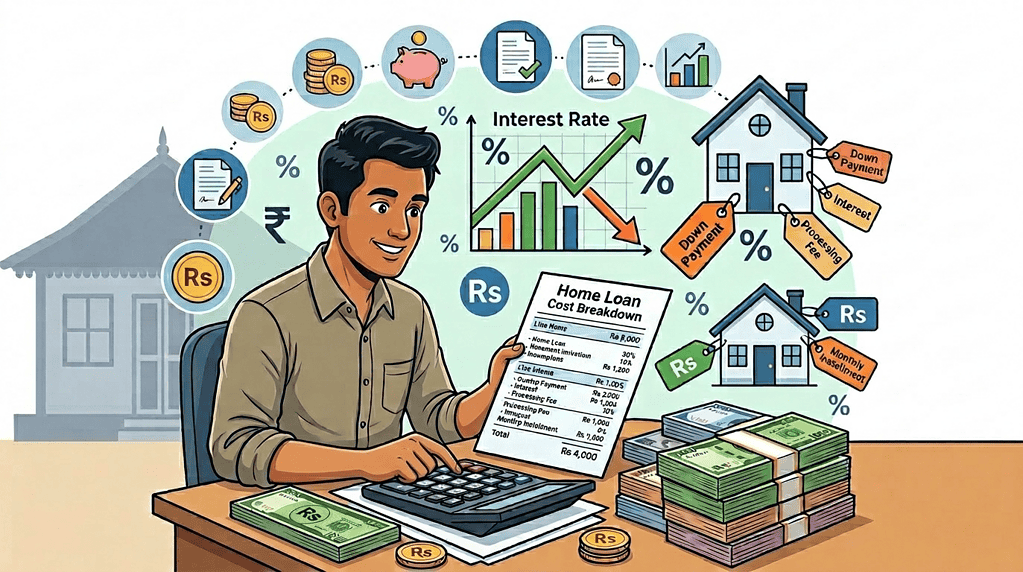
The best bank for home loans in Sri Lanka isn’t always the one with the lowest rate. Look at total cost, repayment flexibility, processing speed, and LTV ratio before you decide.
Before I get into the bank-by-bank comparison, here is what actually matters when choosing where to take your housing loan in Sri Lanka. Most people fixate on the home loan interest rate in Sri Lanka alone. That’s a mistake.
Interest Rate: Fixed vs. Variable
A fixed rate locks your monthly repayment amount for a set period (typically 3 to 20 years depending on the bank). A variable rate fluctuates with market conditions. Fixed rates give you predictability. Variable rates can save you money if rates drop, but they can also increase your repayment if rates rise.
In the current Sri Lankan market, where rates have been volatile over the past few years, a fixed-rate loan gives peace of mind. DFCC Bank is currently the only bank in Sri Lanka offering a 20-year fixed rate, which is a significant advantage if you want long-term certainty.
Loan-to-Value Ratio (LTV)
This is how much of the property value the bank will finance. Most Sri Lankan banks offer 70% to 80% LTV, meaning you need a 20% to 30% down payment. DFCC stands out here by offering up to 100% financing through selected development partners, which means you could potentially buy a home with zero down payment if the property qualifies.
Repayment Flexibility
Not all repayment structures are the same. Some banks only offer standard equal monthly installments (EMI). Others offer stepped-up plans where your payments start low and increase over time, grace periods, or balloon payment options.
More flexibility means you can tailor the loan to your actual financial situation. Stepped-up plans are especially useful for young professionals expecting salary growth.
Processing Speed and Hassle
When you find the right property, timing matters. If another buyer is also interested, the bank that can approve and disburse your loan faster wins. Processing times range from 3 days (Commercial Bank) to 14 days (some government banks).
Also consider how many documents they require, how many branch visits you’ll need, and whether they offer home or office visits for the application process.
Total Cost of Ownership
Beyond the interest rate, calculate:
– Processing fees: Typically 0.5% to 1% of the loan amount
– Legal fees: Title search, document preparation, attorney costs
– Valuation charges: Property assessment fees
– Insurance: Decreasing Term Assurance (life insurance) and fire/SRCC insurance are mandatory for most banks
– Early settlement penalties: Some banks charge 1% to 3% if you pay off the loan early
A bank with a slightly higher interest rate but lower fees and no early settlement penalty could end up cheaper over the full loan term.
1. DFCC Bank (Best Overall for Home Loans in 2026)
Best for: Borrowers who want long-term rate certainty, maximum repayment flexibility, and fast processing.
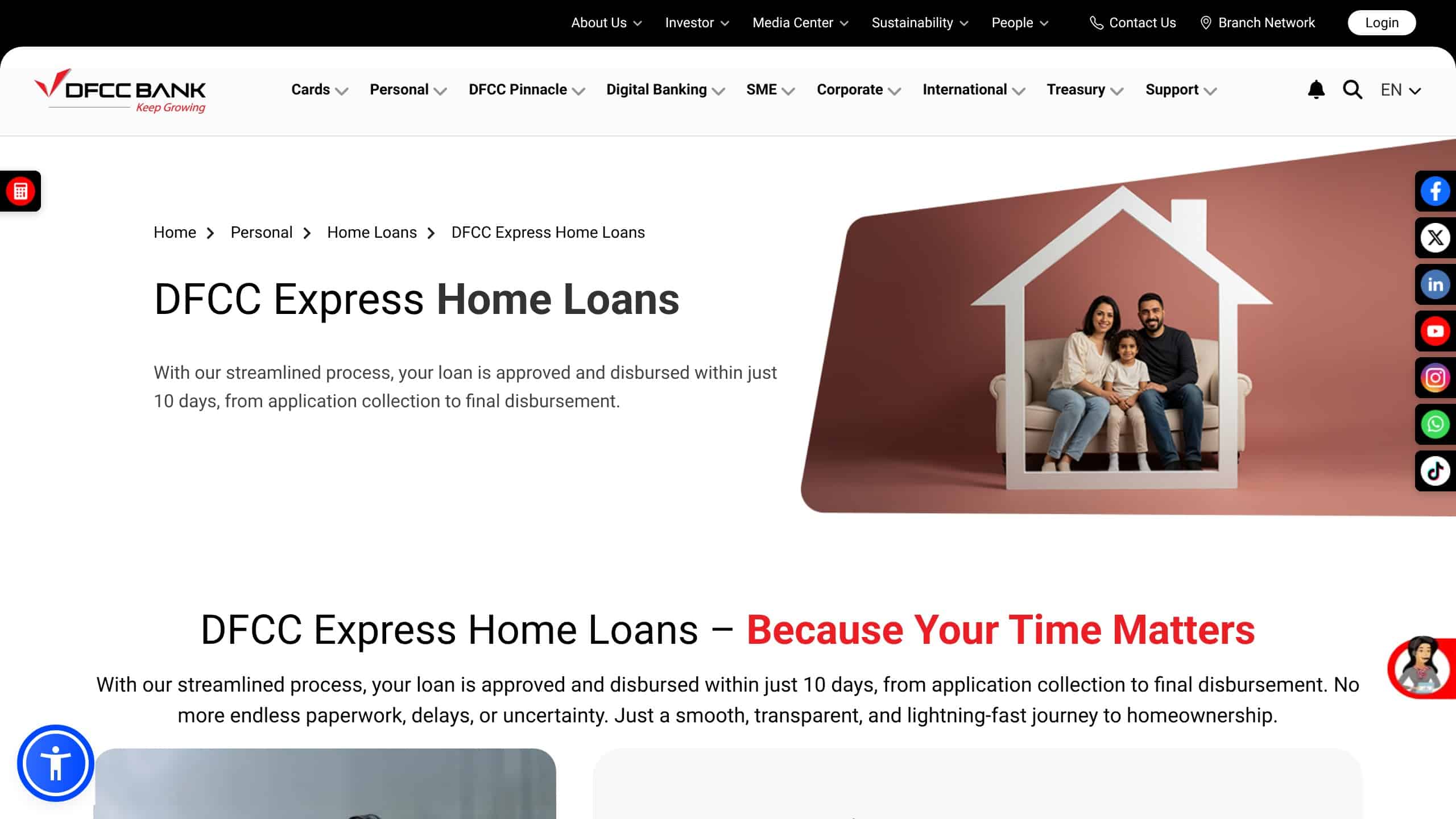
DFCC Bank has positioned itself as the most innovative housing finance provider in Sri Lanka for 2026. Based on my research, that claim holds up. They’re the only bank in the country offering a 20-year fixed-rate home loan, a first for Sri Lanka’s banking industry. If you lived through the interest rate spikes of 2022 and 2023, you already know why locking in a fixed rate for two decades matters.
What Makes DFCC Stand Out
Sri Lanka’s first 20-year fixed-rate home loan. No other bank offers this. Most fixed-rate options in Sri Lanka cap at 3 to 5 years before reverting to variable rates. DFCC’s 20-year fixed rate means your monthly repayment stays the same for the entire period, regardless of what happens with CBSL policy rates. If you’re someone who budgets carefully and hates surprises, this is the product for you.
Up to 100% financing with partner developers. If you’re buying from one of DFCC’s selected development partners, you may not need any down payment at all. For other properties, they offer up to 75% of the Fair Sale Value (FSV) and Bill of Quantities (BOQ).
The 100% financing option is rare in Sri Lanka. It removes the biggest barrier for first-time homebuyers who have the income to service a loan but haven’t yet saved a full 20% to 30% deposit.
10-day disbursal guarantee. DFCC guarantees loan disbursal within 10 days from complete application submission. They also offer pre-approval in just one working day. That means you can go property hunting knowing exactly how much you can borrow before you start negotiating.
Four structured repayment options. This is where DFCC genuinely outperforms every other bank I reviewed:
- Stepped-up repayments: Start with smaller payments (10% of loan equity in years 1-3), increasing to 30% in years 3-6 and 60% in years 6-10. Ideal for young professionals expecting salary growth.
- Grace period structure: A 5-year grace period where you pay only interest, with full repayments starting afterward. Maximum 20-year tenure. Perfect for professionals like doctors or engineers whose income will increase significantly after early career years.
- Lump-sum principal payments: Pay monthly interest only, with one annual lump-sum capital payment at year-end. Maximum 10-year tenor. Suits business owners or self-employed individuals with irregular income patterns.
- Flexible balloon payment: Equal monthly capital repayments with 50% of the capital due as a lump sum at maturity, with the option to roll over that final 50% for an additional 5 years. Good for those expecting a future windfall (inheritance, investment maturity, or property sale).
No other bank in Sri Lanka offers all four of these structures.
DFCC Home Loan Details
| Feature | Details |
|---|---|
| Maximum Financing | Up to 100% (partner developers), up to 75% FSV/BOQ (others) |
| Maximum Tenure | 30 years (purchase/construction), 20 years (land/renovation) |
| Minimum Income | Rs. 50,000/month gross |
| Interest Rate Options | Fixed (up to 20 years) or Variable |
| Pre-Approval | 1 working day |
| Disbursal | 10-day guarantee |
| Repayment Options | EMI, reducing balance, stepped-up, grace period, lump-sum, balloon |
| Eligible Purposes | Property purchase, construction, renovation, land acquisition, home improvements, condominium purchase |
Eligibility and Documents
To apply for a DFCC Express Home Loan, you need:
- Minimum monthly gross income of Rs. 50,000 (base salary plus fixed allowances plus 50% of variable allowances)
- Suitable Debt Service Coverage Ratio (DSCR), meaning your existing loan commitments plus the new home loan repayment shouldn’t exceed a certain percentage of your income
- Currently available for salaried individuals (self-employed borrowers should inquire about the structured housing loan product)
Required documents:
– Completed application form
– Vendor consent letter with confirmed sale price
– Employer confirmation letter
– Last 6 months salary slips
– Last 6 months bank statements
– Last 3 years tax returns
– Title deeds for the property
– Approved survey plan
– Local authority building approval (for construction)
– Decreasing Term Assurance (life insurance) and fire/SRCC insurance policies
Who Should Choose DFCC?
Choose DFCC if you want the most flexible home loan structure in Sri Lanka. It’s also the right pick if you value long-term fixed rate security, or if you’re buying from a partner developer and want 100% financing. The 10-day disbursal guarantee makes DFCC a strong choice when timing is critical.
The main limitation? Their Express Home Loan is currently available only to salaried individuals. If you’re self-employed, ask about their structured housing loan product instead. It has a minimum income requirement of Rs. 100,000/month and requires 3 years of audited financial statements.
Contact DFCC: Call 011 244 2076 (24/7 hotline) or visit any DFCC Bank branch. You can also request a home or office visit from a dedicated loan specialist.
2. Bank of Ceylon (Best Government Bank Option)
Best for: Borrowers who want government-backed security, an extensive branch network, and competitive rates.
Bank of Ceylon (BOC) is the largest government-owned commercial bank in Sri Lanka, and their housing loan portfolio reflects that scale. With branches in every district and deep roots in rural areas, BOC is the natural choice for borrowers outside Colombo who want face-to-face service.
What Makes BOC Stand Out
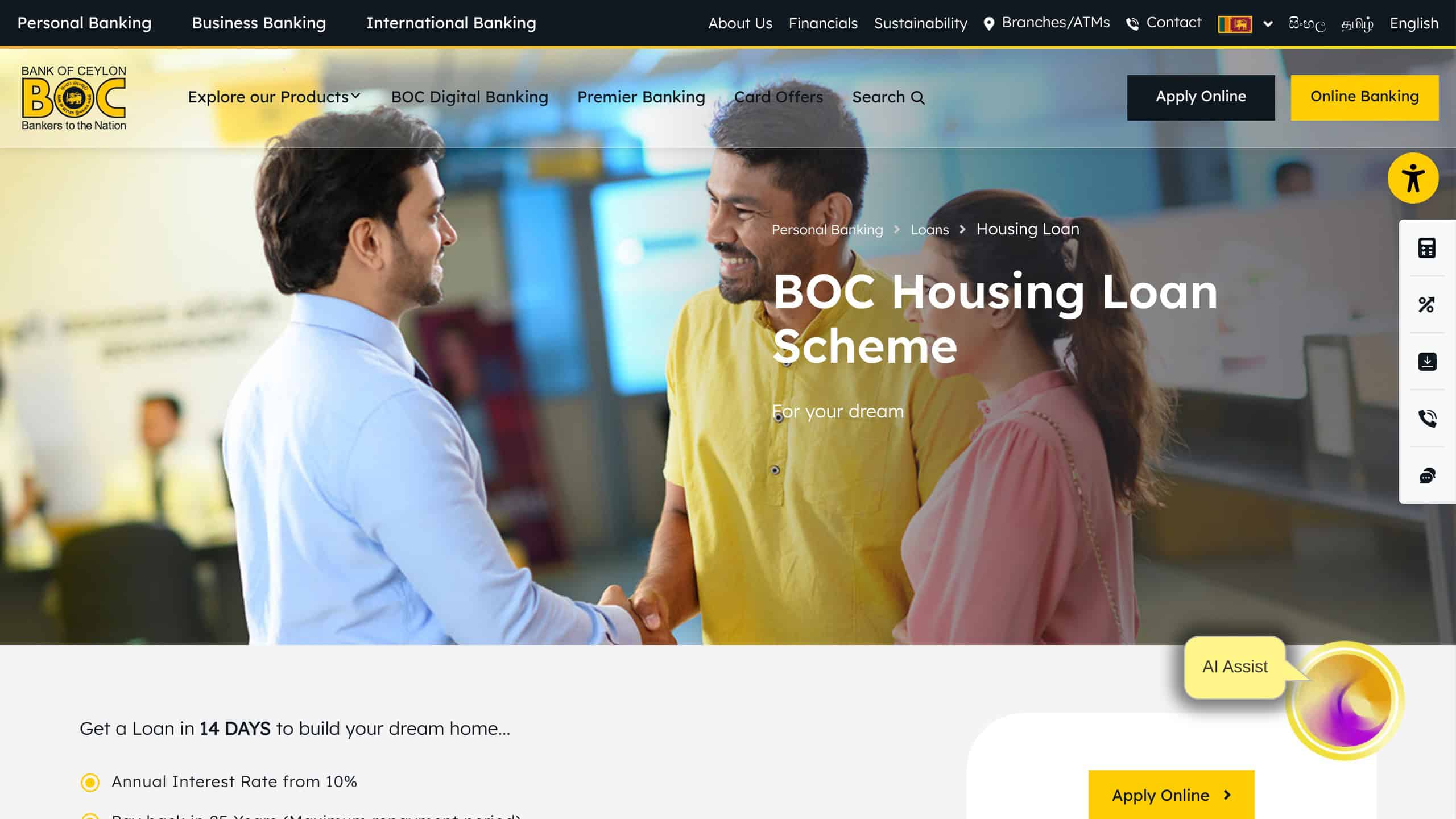
14-day fast-track housing loan scheme. BOC introduced a fast-track housing loan processing system that promises approval and disbursal within 14 days for eligible applicants. Given that some government bank processes historically took 4 to 8 weeks, this is a meaningful improvement.
Island-wide branch network. With over 600 service outlets across all 25 districts, BOC is accessible everywhere. If you’re buying property in Anuradhapura, Batticaloa, or Hambantota, BOC likely has a branch within a reasonable distance, which matters when you need to submit documents, sign papers, or resolve issues in person.
Multiple housing loan schemes. BOC offers several specialized products including their standard housing loan, a green housing loan for energy-efficient homes, and special schemes for government employees and lower-income borrowers. The variety means you can find a scheme that matches your specific situation rather than forcing yourself into a one-size-fits-all product.
Competitive rates for government employees. If you work for a government ministry, department, or state-owned enterprise, BOC often offers preferential rates that private banks can’t match. This includes salary deduction arrangements where your employer remits the loan repayment directly from your salary, reducing default risk and sometimes earning you a lower rate.
BOC Home Loan Details
| Feature | Details |
|---|---|
| Maximum Financing | Up to 80% of property value (varies by scheme) |
| Maximum Tenure | Up to 25 years |
| Minimum Income | Varies by scheme (lower thresholds for concessionary schemes) |
| Interest Rate Options | Fixed and variable options available |
| Processing Speed | 14 days (fast-track scheme) |
| Repayment Options | EMI and reducing balance |
| Eligible Purposes | Property purchase, construction, renovation, land purchase |
| Special Schemes | Green housing loans, government employee schemes, concessionary schemes |
Who Should Choose BOC?
Choose BOC if you are a government employee, if you need a branch nearby in a rural or semi-urban area, or if you qualify for one of their concessionary schemes. Also consider BOC if you already bank with them, as existing customers often get faster processing and better terms.
The main limitation is that processing can still be slower than private banks for non-fast-track applications, and the bureaucratic process at some branches can test your patience. Arrive early, bring every document on the checklist, and bring photocopies.
3. Commercial Bank (Best for High-Value Loans)
Best for: High-income borrowers, large property purchases, and those who want fast approval with material cost savings.
Commercial Bank of Ceylon is the largest private commercial bank in Sri Lanka by assets, and their home loan product reflects a focus on higher-value borrowers. If you’re buying a property worth Rs. 20 million or more, Commercial Bank should be on your shortlist.
What Makes Commercial Bank Stand Out
Highest loan ceiling in the market. Commercial Bank offers home loans from Rs. 500,000 up to Rs. 50 million, with the possibility of negotiating higher amounts for qualifying borrowers. Most other banks cap their standard housing loan at Rs. 20 to 30 million, so if you are looking at a luxury apartment in Colombo 3 or a large family home in Nugegoda, Commercial Bank can accommodate the full amount.
3-day loan approval. Commercial Bank promises loan approval within 3 working days from complete application submission. That’s one of the fastest turnaround times in the market and can be the difference between securing and losing the property you want.
Building material discounts up to 40%. This is unique. Commercial Bank has partnerships with building material suppliers that give their home loan borrowers discounts of up to 40% on construction materials. If you’re building a house rather than buying an existing property, this can save you lakhs of rupees.
Interest rate reductions for existing customers. Achiever account holders and certain digital account holders get a 0.25% rate reduction. Salaried employees earning above Rs. 200,000/month and qualified professionals (doctors, engineers, lawyers, chartered accountants) get a 0.50% reduction.
Over a 20-year loan, a 0.50% reduction on Rs. 15 million saves you roughly Rs. 960,000 in interest. That’s real money.
Foreign currency home loans. If you’re a Sri Lankan working abroad and hold a Non-Resident Foreign Currency (NRFC) account at Commercial Bank, you can take a home loan in foreign currency. This is relevant for diaspora members buying property in Sri Lanka who earn in dollars, pounds, or euros.
Commercial Bank Home Loan Details
| Feature | Details |
|---|---|
| Maximum Financing | Rs. 500,000 to Rs. 50 million (negotiable higher) |
| Maximum Tenure | 20 years (salaried), 10 years (business) |
| Minimum Income | Rs. 40,000/month net (individual or joint) |
| Interest Rate Options | Fixed and variable, with reductions for existing customers |
| Processing Speed | 3 working days |
| Repayment Options | EMI and reducing monthly installment |
| Eligible Purposes | Property purchase, construction, renovation, loan transfer |
| Special Features | Building material discounts up to 40%, foreign currency loans |
Who Should Choose Commercial Bank?
Choose Commercial Bank if you need a loan above Rs. 30 million, if you’re building a home and want material cost savings, or if you already bank with them for the rate discount. It’s also the go-to for diaspora members who need a foreign currency home loan. The 3-day approval is valuable in competitive property markets.
The main limitation is the shorter tenure for business customers (10 years vs. 20 years for salaried), and the minimum income requirement of Rs. 40,000 means it’s accessible but not the cheapest entry point.
4. Hatton National Bank (Best for Digital-First Borrowers)
Best for: Tech-savvy borrowers who want a strong digital banking experience alongside their home loan.
HNB is one of Sri Lanka’s largest private banks and has invested heavily in digital banking infrastructure. Their home loan product is competitive on rates and backed by a digital platform that makes tracking your application, managing repayments, and accessing account information easy.
What Makes HNB Stand Out
Online application and tracking. HNB lets you start your home loan application online and track its progress through their digital channels. While you’ll still need to visit a branch for document verification and signing, the ability to initiate the process from home and monitor status updates online saves time.
Competitive interest rates. HNB consistently offers rates in the lower range of the market, particularly for existing customers with a strong banking relationship. Their home loan rates are benchmarked against market conditions and adjusted regularly.
Loan tenure up to 25 years. Longer than Commercial Bank’s 20-year maximum for salaried customers, giving you the option to spread payments over a longer period and reduce your monthly commitment.
Strong presence in Western Province. If you’re buying property in Colombo, Gampaha, or Kalutara districts, HNB has a dense branch network in the Western Province that makes in-person interactions convenient.
Who Should Choose HNB?
Choose HNB if you value digital banking convenience, if you’re an existing HNB customer, or if you want competitive rates with a long repayment period. HNB is particularly strong for salaried professionals in the Western Province.
5. Sampath Bank (Best for Personalized Service)
Best for: Borrowers who want dedicated relationship management and tailored loan structures.
Sampath Bank’s Sevana Housing Loan is a well-established product in Sri Lanka’s housing finance market. Sampath has a reputation for personalized service, with dedicated relationship managers assigned to home loan customers.
What Makes Sampath Stand Out
Dedicated housing loan relationship managers. Unlike banks where your application passes through multiple departments with no single point of contact, Sampath assigns a relationship manager who guides you through the entire process from application to disbursal.
Tenure up to 25 years. Competitive with the longest tenures available in the market.
Flexible collateral requirements. Sampath considers the property being purchased as primary collateral and may accept other collateral arrangements depending on the borrower’s profile, which can be helpful if the property’s valuation is slightly below the loan amount you need.
Who Should Choose Sampath?
Choose Sampath if you value having a single person you can call throughout the loan process, if you’re an existing Sampath customer, or if you need flexibility on collateral arrangements. Sampath is a solid mid-market option.
6. Nations Trust Bank (Best for Quick Decisions)
Best for: Borrowers who need fast processing and straightforward terms.
Nations Trust Bank markets their Nations Home Loan as offering some of the best housing loan rates in Sri Lanka. They focus on a streamlined process with fewer hurdles.
What Makes Nations Trust Stand Out
Streamlined application process. Nations Trust has simplified their documentation and approval workflow, which typically results in faster processing times than larger banks with more bureaucratic procedures.
Competitive rates. Nations Trust Bank positions their home loan rates aggressively to compete with larger banks, particularly for salaried professionals.
Flexible loan purposes. Beyond standard property purchase and construction, Nations Trust accommodates a range of housing-related financing needs.
Who Should Choose Nations Trust?
Choose Nations Trust if you want a private bank experience with competitive rates and less bureaucracy. Good for straightforward salaried employee applications where speed matters.
7. People’s Bank (Best for Low-Income Borrowers)
Best for: Government employees, lower-income earners, and those who qualify for concessionary schemes.
People’s Bank is the second-largest government-owned bank in Sri Lanka, and their housing loan portfolio includes several concessionary schemes designed to make homeownership accessible to lower-income Sri Lankans.
What Makes People’s Bank Stand Out
Concessionary housing loan schemes. People’s Bank offers special housing loan products with subsidized interest rates for government employees, teachers, military personnel, and lower-income borrowers. These rates are typically 2 to 4 percentage points below standard market rates.
Low entry barriers. The minimum income requirements for People’s Bank concessionary schemes are lower than private banks, making homeownership accessible to a broader range of Sri Lankans.
Payroll deduction facility. For government employees, loan repayments can be deducted directly from salary, simplifying the repayment process and sometimes earning preferential rates.
Massive branch network. With branches across all 25 districts, including deep rural areas, People’s Bank is accessible to borrowers everywhere.
Who Should Choose People’s Bank?
Choose People’s Bank if you are a government employee, if your income is below the minimum thresholds of private banks, or if you qualify for one of their concessionary schemes. The rates on concessionary products are hard to beat.
The trade-off is slower processing and a more bureaucratic experience compared to private banks.
8. National Savings Bank (Best for First-Time Buyers)
Best for: First-time homebuyers, savers with NSB accounts, and those who want government-backed security.
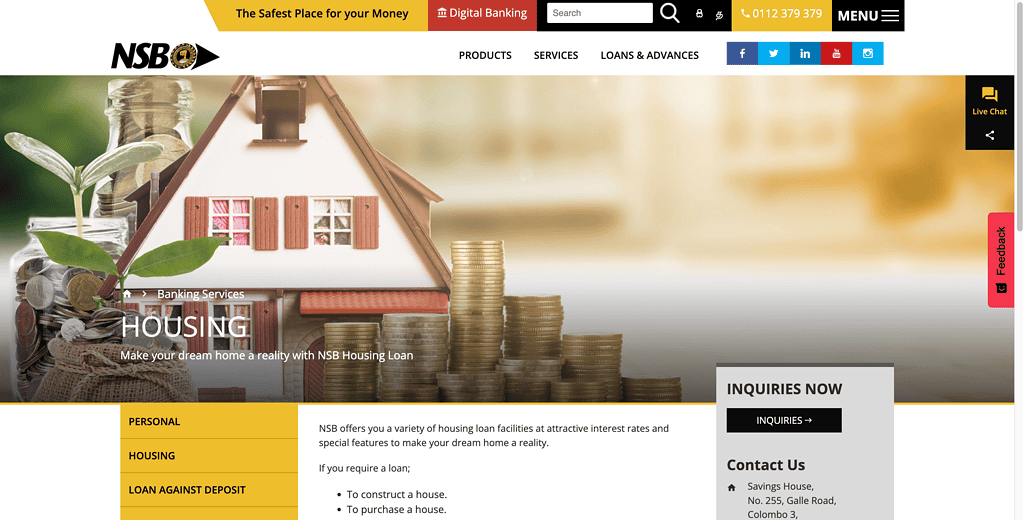
NSB occupies a unique position as a government-owned savings bank with a strong housing loan portfolio. If you have been saving with NSB, their housing loan products reward that loyalty.
What Makes NSB Stand Out
Preferential rates for long-term savers. If you have maintained an NSB savings account for an extended period, you may qualify for reduced interest rates on housing loans. NSB rewards the savings relationship.
Government guarantee. As a government-owned bank, NSB deposits and lending carry an implicit government guarantee, which provides an extra layer of security for borrowers.
Concessionary schemes. Similar to People’s Bank, NSB offers concessionary housing loan schemes for specific categories of borrowers, including government employees and lower-income earners.
Longer tenure options. NSB offers tenures up to 25 years, helping to keep monthly repayments manageable.
Who Should Choose NSB?
Choose NSB if you have been an NSB saver and want to leverage that relationship, if you’re a first-time buyer who qualifies for concessionary rates, or if you prefer the security of a government bank. Good for conservative borrowers who prioritize stability over speed.
9. Seylan Bank (Best for Construction Loans)
Best for: Borrowers building a home from scratch who want stage-wise disbursement.
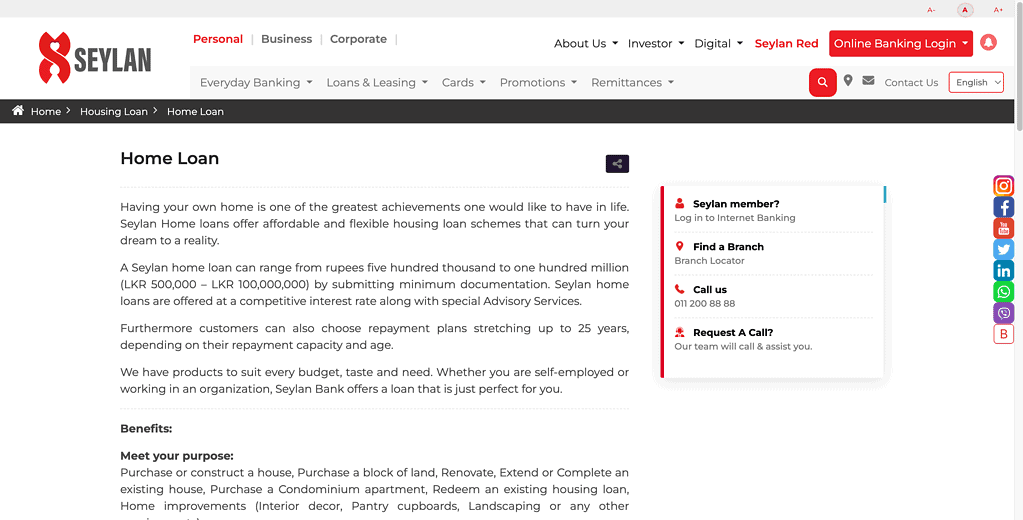
Seylan Bank’s home loan product is well-suited for construction projects, where the loan is disbursed in stages as construction progresses rather than as a single lump sum.
What Makes Seylan Stand Out
Stage-wise disbursement for construction. Seylan disburses the loan in stages aligned with construction milestones (foundation, walls, roof, finishing). This reduces interest costs because you only pay interest on the amount disbursed, not the full loan, during construction.
Competitive rates. Seylan’s housing loan rates are competitive with other private banks and they frequently run promotional offers.
Tenure up to 20 years. Standard for a private bank, with flexible repayment options.
Who Should Choose Seylan?
Choose Seylan if you’re building a house and want the financial advantage of stage-wise disbursement. Also consider Seylan if you’re an existing customer, as they offer better terms for relationship customers.
10. SDB Bank (Best for Affordable Housing)
Best for: Middle-income borrowers looking for straightforward, affordable housing loans.
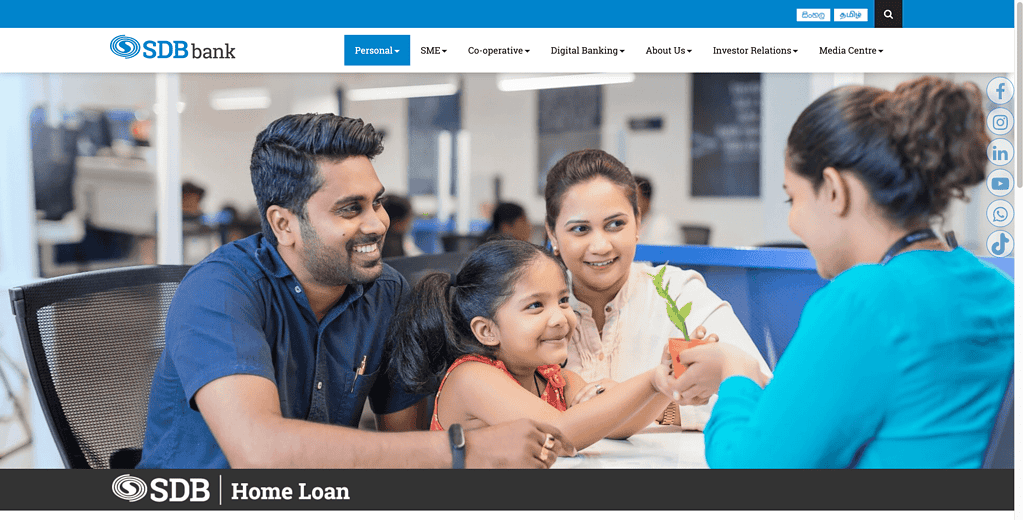
SDB Bank (formerly Sanasa Development Bank) has carved a niche in affordable housing finance, focusing on the Rs. 2 million to Rs. 15 million loan range that serves the majority of Sri Lankan homebuyers.
What Makes SDB Stand Out
Focus on affordable housing. While bigger banks chase high-value loans, SDB focuses on the middle market. Their processes, documentation, and eligibility criteria are designed for the average Sri Lankan worker.
Competitive rates for the segment. SDB often offers rates that are competitive with, or slightly below, the major private banks for loans in the affordable housing range.
Simpler processes. Less paperwork and more straightforward requirements than the larger banks, which appeals to first-time borrowers who find the process intimidating.
Who Should Choose SDB?
Choose SDB if you need a loan in the Rs. 2 million to Rs. 15 million range and want a bank that specializes in serving borrowers at your level rather than treating you as a secondary priority behind wealthy clients.
11. State Mortgage and Investment Bank (Best Government Housing Specialist)
Best for: Borrowers who want a bank that specializes exclusively in housing finance.
The State Mortgage and Investment Bank (SMIB) is a government-owned institution that exists primarily to provide housing finance. Unlike commercial banks where housing loans are one product among many, SMIB’s entire focus is helping Sri Lankans buy homes.
What Makes SMIB Stand Out
Housing-only focus. SMIB’s entire operation revolves around housing finance. Their staff specialize in property assessment, housing law, and mortgage processing. You’re not competing for attention with corporate banking clients or credit card applicants.
Government-backed rates. As a government institution, SMIB can offer rates that reflect government housing policy priorities, which sometimes means concessionary rates for specific schemes.
Specialized property expertise. SMIB’s valuers and legal team have deep expertise in property assessment across Sri Lanka, which can be valuable if you’re buying in areas where private bank valuers have less experience.
Who Should Choose SMIB?
Choose SMIB if you want a bank whose entire purpose is housing finance, if you qualify for government concessionary schemes, or if you’re buying property in an area where larger banks have limited presence. SMIB is particularly relevant for borrowers in rural areas building homes under government housing programs.
The trade-off is slower processing and a smaller branch network compared to BOC or People’s Bank.
12. HDFC Bank Sri Lanka (Best for Rural Housing)
Best for: Low-income and rural borrowers, government housing scheme participants.
HDFC Bank (Housing Development Finance Corporation of Sri Lanka) is a government-affiliated institution specifically created to promote homeownership among lower-income Sri Lankans, particularly in rural areas.
What Makes HDFC Stand Out
Lowest entry barriers. HDFC’s Sirisara Housing Loan has some of the lowest minimum income requirements in the market, making homeownership accessible to borrowers that commercial banks wouldn’t typically serve.
Concessionary interest rates. HDFC offers rates that are typically below market rates, subsidized through government housing development programs.
Rural reach. HDFC actively serves borrowers in rural and semi-urban areas where other banks have minimal presence.
Government housing scheme participation. HDFC is a key implementation partner for national housing development programs, meaning they can connect borrowers with government subsidy schemes that reduce the effective cost of homeownership.
Who Should Choose HDFC?
Choose HDFC if you are a lower-income borrower in a rural area, if you’re participating in a government housing development scheme, or if your income falls below the minimum requirements of commercial banks. HDFC exists specifically to serve borrowers that the mainstream banking system overlooks.
How to Calculate Your Home Loan Affordability
Your total monthly debt repayments shouldn’t exceed 40% of your gross income. Most banks in Sri Lanka use this threshold to determine your home loan eligibility.
Before you walk into any bank, do this math first. Too many Sri Lankans take out home loans they can technically qualify for but practically struggle to repay.
The 40% Rule
Your total monthly debt repayments (home loan plus any existing personal loans, leasing, or credit card minimum payments) shouldn’t exceed 40% of your gross monthly income. Most banks in Sri Lanka use a similar threshold, but I recommend being more conservative and keeping it under 35%.
Example:
– Monthly gross income: Rs. 150,000
– 40% threshold: Rs. 60,000 maximum for all loan repayments
– Existing car lease: Rs. 15,000/month
– Available for home loan repayment: Rs. 45,000/month
At Rs. 45,000/month over 20 years at 12% interest, you can afford a home loan of approximately Rs. 4 million. If that number feels low compared to property prices in your target area, you have three options: increase your income, reduce your other debts, or extend the loan tenure (which is where DFCC’s 30-year option becomes valuable).
Hidden Costs to Budget For
When Nadeesha, a teacher in Kandy, got approved for her home loan in 2025, she was surprised by the additional costs that came before she even moved in:
- Stamp duty: 3% to 4% of the property value
- Legal fees: Rs. 50,000 to Rs. 200,000 depending on property value and complexity
- Valuation fee: Rs. 5,000 to Rs. 25,000
- Processing fee: 0.5% to 1% of the loan amount
- Insurance premiums: Decreasing Term Assurance (DTA) and fire insurance, typically Rs. 15,000 to Rs. 50,000/year combined
- Title search: Rs. 5,000 to Rs. 15,000
For a Rs. 10 million property with an Rs. 8 million loan, these additional costs can add up to Rs. 400,000 to Rs. 600,000. Budget for them separately and don’t use your down payment savings to cover them.
If you are planning to buy beach property in Sri Lanka, factor in higher insurance premiums for coastal locations and check whether the property falls within restricted coastal zone regulations.
Step-by-Step: How to Apply for a Home Loan in Sri Lanka
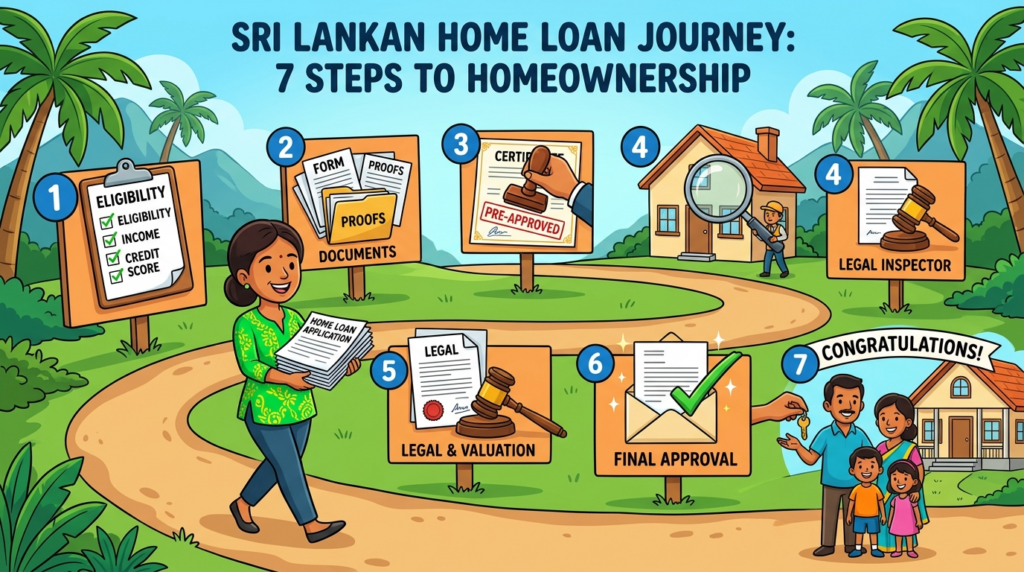
The home loan application process in Sri Lanka takes 7 steps from eligibility check to disbursal, and typically 3 to 14 days depending on the bank.
Here’s the general process that applies to most banks. Individual banks may have slight variations.
Step 1: Check Your Eligibility
Before visiting a bank, confirm:
– Your monthly income meets the minimum requirement
– You have stable employment (most banks want at least 1 year with current employer for salaried applicants)
– Your existing debt level leaves room for a home loan
– You have the required down payment saved (unless using DFCC’s 100% financing option)
Step 2: Gather Your Documents
Personal documents:
– NIC (National Identity Card) and copies
– Proof of address (utility bill or bank statement)
– Passport-size photographs
Income documents (salaried):
– Employer confirmation letter stating salary, position, and tenure
– Last 6 months salary slips
– Last 6 months bank statements showing salary credits
– Last 3 years tax returns or TIN registration
Income documents (self-employed):
– Business registration certificate
– Last 3 years audited financial statements
– Last 3 years tax returns
– Last 6 months business bank statements
Property documents:
– Title deed (original and certified copies)
– Approved survey plan
– Local authority building approval (for construction)
– Building plan approved by the local council
– Vendor consent letter with confirmed sale price
– Current tax receipts for the property
Step 3: Get Pre-Approval
Visit the bank or apply online (where available) for pre-approval. Pre-approval tells you the maximum loan amount you qualify for and the indicative interest rate. DFCC offers pre-approval in 1 working day. Commercial Bank takes about 3 days. Other banks vary.
Pre-approval is not a final commitment from the bank. It’s conditional on property valuation and final document verification. But it gives you bargaining power when negotiating with property sellers.
Step 4: Property Valuation
Once you identify a property, the bank sends a valuer to assess it. The bank will lend based on the valuation, not the asking price. If the valuation comes in lower than the sale price, you need to cover the difference from your own funds.
Step 5: Legal Verification
The bank’s legal team (or an appointed attorney) conducts a title search to verify that the seller has clear ownership, there are no encumbrances or liens, and the property is legally transferable.
Step 6: Loan Approval and Offer Letter
If everything checks out, the bank issues a formal offer letter detailing the loan amount, interest rate, tenure, repayment schedule, and conditions. Read this carefully. Pay attention to clauses about rate changes, penalties, and insurance requirements.
Step 7: Signing and Disbursement
Sign the loan agreement, mortgage bond, and insurance documents. The bank registers the mortgage with the land registry. Once registered, the loan is disbursed, either as a lump sum (for purchases) or in stages (for construction).
Frequently Asked Questions
What is the lowest home loan interest rate in Sri Lanka in 2026?
Housing loan interest rates in Sri Lanka in 2026 range from approximately 10% to 14% per annum depending on the bank, loan type (fixed or variable), and borrower profile. Government banks like BOC, People’s Bank, and NSB offer concessionary rates for eligible borrowers that can go below standard market rates. DFCC Bank offers Sri Lanka’s only 20-year fixed-rate option, providing long-term rate certainty.
Can I get a home loan in Sri Lanka without a down payment?
DFCC Bank offers up to 100% financing when you purchase from their selected development partners, which means zero down payment may be possible. Most other banks require a 20% to 30% down payment (70% to 80% LTV ratio). The ability to get a home loan without a down payment is rare in Sri Lanka and is one of DFCC’s strongest advantages for first-time buyers.
How much home loan can I get on a Rs. 100,000 salary in Sri Lanka?
On a gross monthly salary of Rs. 100,000, most banks will approve a home loan where the monthly repayment doesn’t exceed 40% of your income (Rs. 40,000/month). At current interest rates around 12% over 20 years, that translates to a maximum loan of approximately Rs. 3.5 million to Rs. 4 million, depending on existing debts and the specific bank’s criteria.
Can self-employed people get home loans in Sri Lanka?
Yes, but the requirements are stricter. Most banks require self-employed borrowers to provide 3 years of audited financial statements, business registration documents, tax returns, and bank statements showing consistent income. DFCC’s structured housing loan product caters to self-employed professionals and business owners with a minimum income of Rs. 100,000/month. Commercial Bank also accepts business customers but limits their tenure to 10 years instead of 20.
Can Sri Lankans living abroad get a home loan in Sri Lanka?
Yes. Several banks offer home loans to Sri Lankans in the diaspora. Commercial Bank offers foreign currency home loans for Non-Resident Foreign Currency (NRFC) account holders. BOC has a special housing loan scheme for Sri Lankans resident outside of Sri Lanka on permanent residency visas. The documentation requirements include proof of overseas income, employment verification, and typically a higher down payment (30% to 40%).
What happens if I can’t repay my home loan?
If you miss payments, the bank will first send reminders and charge late payment fees. After prolonged default (typically 3 to 6 months of missed payments), the bank can initiate recovery proceedings, which may include auctioning the mortgaged property to recover the outstanding loan amount. If you foresee financial difficulty, contact your bank immediately. Most banks, including DFCC with their flexible repayment restructuring options, will work with you to adjust the repayment schedule rather than resort to recovery.
Should I take a fixed or variable rate home loan?
In Sri Lanka’s current environment where interest rates have been coming down from their 2022-2023 peaks, a variable rate gives you the benefit of lower payments as rates decrease. However, if you want certainty and protection against future rate increases, a fixed rate is safer. DFCC’s 20-year fixed rate is the longest fixed-rate option available in Sri Lanka, offering maximum predictability. A common strategy is to take a fixed rate for the first 5 years and then reassess.
How long does it take to get a home loan approved in Sri Lanka?
Processing times vary significantly. Commercial Bank promises 3 working days. DFCC guarantees disbursal within 10 days. HNB and Sampath typically take 5 to 7 days. Government banks like BOC (14 days fast-track), People’s Bank, and NSB may take 7 to 14 days or longer for concessionary schemes. The key factor is submitting a complete application with all required documents on the first visit. Incomplete applications are the number one cause of delays.
Final Verdict: Which Is the Best Bank for Home Loans in Sri Lanka?
There’s no single best bank for every borrower. But here is my honest recommendation based on weeks of research into housing loan rates and terms across the market:
If you want the best overall package in 2026, go with DFCC Bank. Sri Lanka’s only 20-year fixed rate, up to 100% financing, a 10-day disbursal guarantee, and four different repayment structures. No other bank gives you this combination of options and certainty. For salaried professionals earning Rs. 50,000 or more per month, DFCC should be your first call.
If you need a loan above Rs. 30 million, Commercial Bank’s Rs. 50 million ceiling and 3-day approval make it the practical choice for high-value purchases.
If you’re a government employee, start with BOC or People’s Bank. Their concessionary schemes and salary deduction arrangements can save you significantly.
If you are a first-time buyer with limited savings, DFCC’s 100% financing option (with partner developers) or HDFC’s low-entry-barrier products may be your path to homeownership.
If you’re in the Sri Lankan diaspora, Commercial Bank’s foreign currency home loan or BOC’s non-resident scheme are purpose-built for your situation.
Whatever bank you choose, get quotes from at least three banks before committing. This home loan comparison in Sri Lanka covers the major players, but your personal situation determines which one wins. Bring the same documentation to each bank and compare the total cost of the loan (not just the interest rate) including processing fees, insurance costs, and early settlement terms.
Owning a home in Sri Lanka is achievable. The right bank and the right loan structure can make it affordable. Do the math, read the fine print, and choose the bank that fits your financial reality, not the one with the flashiest advertisement.
If you are also exploring investment opportunities in Sri Lanka or need help with business registration for a property-related venture, our guides cover those processes step by step.
For personal financing options beyond home loans, compare the best loan apps in Sri Lanka for shorter-term needs, or check our finance guides hub for credit cards, insurance, and investment comparisons.
Last verified: April 2026. Interest rates and bank terms change frequently based on Central Bank policy decisions. Confirm current rates directly with the bank before applying. Advice.lk updates this guide regularly. If you find that any information here has changed, drop a comment and I will update it within 24 hours.
Disclosure: This guide is Community Verified. I contacted banks directly and reviewed their published terms. Advice.lk does not accept payments from banks to influence rankings. All recommendations are based on publicly available product features, rates, and terms.
