
Introduction
Picture this. Someone is working on a laptop from a calm beach in the south of Sri Lanka, sipping tea, jumping on calls with clients in Europe, then heading to a temple or surf break before sunset. That person is not a long‑stay tourist bending rules. That person is in the country on the new Sri Lanka Digital Nomad Visa, with clear legal status and far less stress.
Over the last few years, remote work has moved from an experiment to normal life for many professionals, with digital nomad statistics showing exponential growth in remote workers seeking international bases. Governments reacted by creating special visas for foreign remote workers, freelancers, and business owners. Sri Lanka is now part of that group, with a visa that allows one full year in the country (renewable) for people who earn only from abroad and want a stable base in South Asia.
This new visa matters both for visitors and for Sri Lankans. The government uses it to bring in foreign currency and rebuild tourism after the 2024 economic crisis. Remote workers gain a clear rule book instead of guessing what is allowed on a tourist visa. As someone who lives in Sri Lanka and writes for Advice.lk, I follow these policy changes closely and see how they play out on the ground, from immigration counters to banks and rental markets.
In this guide, I walk through everything that matters about the Sri Lanka Digital Nomad Visa in simple, practical language. You will see:
Who qualifies and which documents you need
How to apply step by step
What it costs and how renewals work
What you are allowed to do (and what is off‑limits)
How it compares with the extended 180‑day tourist visa
How Advice.lk helps with visas, banking, housing, and daily life
By the end, a remote worker should know whether this visa fits their plans and exactly what to do next.
Key Takeaways
Before diving into the details, it helps to see the main points in one place. This short summary gives the headline facts so the rest of the guide is easier to follow.
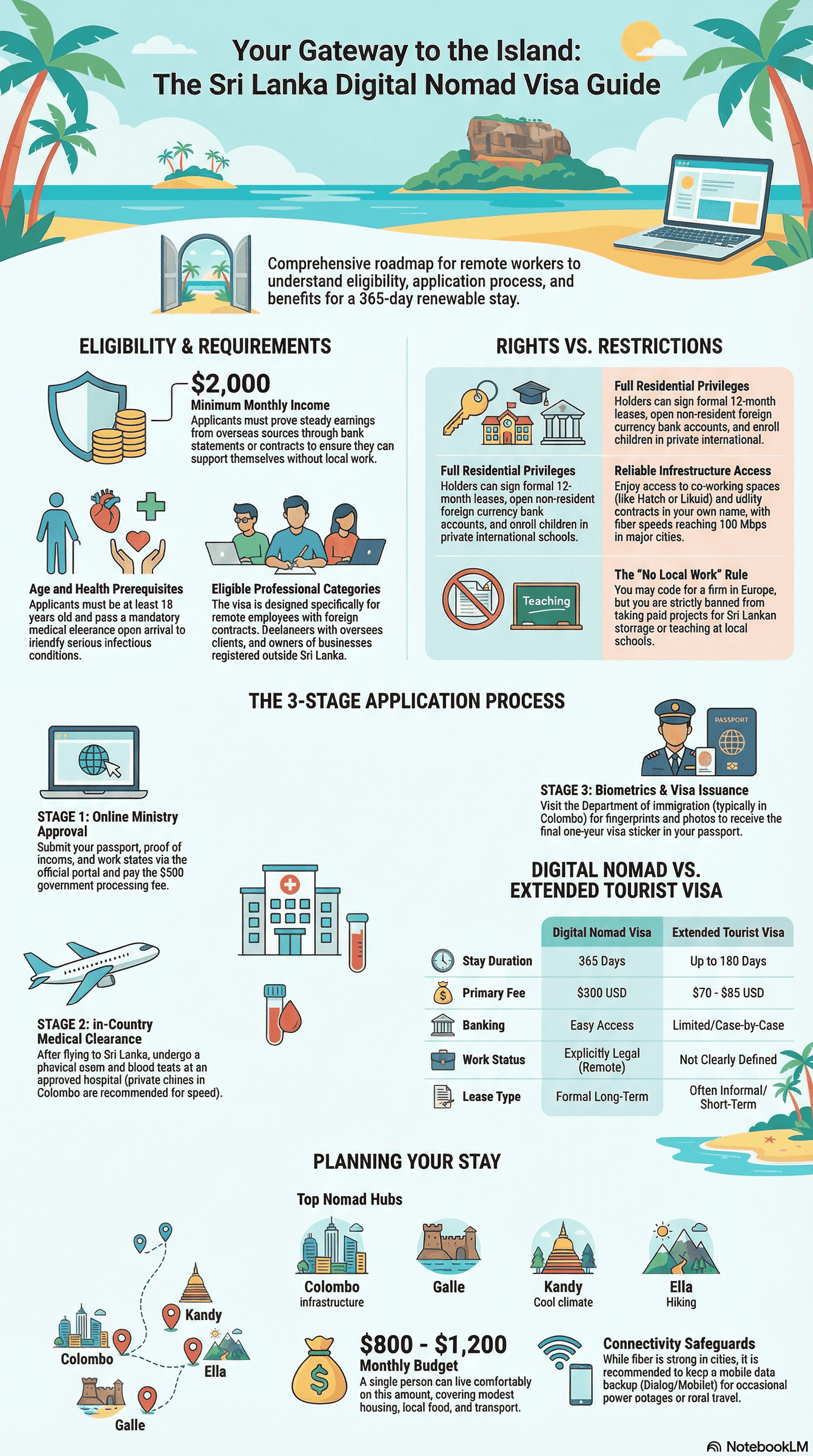
The Sri Lanka Digital Nomad Visa allows legal residence for 365 days at a time. It is designed for people who earn from outside Sri Lanka and want to stay longer than tourists, with options to renew if they still meet the rules and keep a clean record.
The application fee for the first year is 500 US dollars. On top of this, an applicant should plan extra money for medical checks on arrival, document copies, translations if needed, and short trips inside the country for visits to clinics or offices.
Applicants must be at least 18 years old and must show steady income from overseas sources only. The government sets a minimum income level and asks for proof such as contracts or bank statements, because digital nomads are not allowed to take any local job or earn from Sri Lankan clients.
The approval process happens in three main steps:
The Ministry of Digital Economy checks the online application and documents.
After arrival, the applicant completes medical clearance through approved health centers.
The Department of Immigration issues the actual one‑year visa once all checks are passed.
Visa holders gain several important rights such as renting long‑term housing, opening local bank accounts, accessing co‑working spaces, and enrolling children in private schools. At the same time, local employment is strictly banned and work must stay tied to foreign employers or foreign clients.
After the short disruption in 2024 when the eVisa portal was suspended, online systems were adjusted. By February 2025 the government had active online processing for the Sri Lanka Digital Nomad Visa. Even so, it is wise to check the official immigration website for fresh notices before applying.
Compared with the 180‑day tourist visa, the digital nomad visa offers much clearer legal ground for remote work and better access to services like banking. Advice.lk brings all of this into one place with local explanations, so applicants can move from research to action with far less confusion.
What Is the Sri Lanka Digital Nomad Visa?
The Sri Lanka Digital Nomad Visa is a special long‑stay visa for people who earn from outside the country but want to live here for an extended period, following the model of Sri Lanka’s new visa program that launched specifically for remote workers earning at least $2,000 monthly. It targets foreign remote workers, freelancers, and foreign business owners whose companies are registered abroad. Under this visa, they can live in Sri Lanka for one full year while working online for overseas clients or employers.
The idea first appeared as part of Sri Lanka’s plan to rebuild the economy after the 2024 crisis and sharp inflation. At that time, policy makers were looking for ways to bring in stable foreign income without putting pressure on local jobs. Formal details, including online processing, moved forward and by early 2025 the digital nomad category shifted from public talk to a working system.
This visa marks a change from a purely tourist‑focused approach to a mix that also invites long‑term professionals. Traditional tourist visas were built for short holidays and light remote work in the background. In contrast, the Sri Lanka Digital Nomad Visa openly recognizes remote work as the main reason for staying in the country and sets rules around it. That gives both visitors and officials a clear frame.
It also differs from other existing visas:
A standard tourist visa now runs up to 180 days but does not come with rights like opening a bank account or renting long‑term housing in a formal way.
Business visas are meant for short visits linked to meetings or trade, not for quiet laptop work from a beach town.
Investor visas require large capital, such as 100,000 or 200,000 US dollars.
The digital nomad visa sits between these, offering legal residence without a huge investment and without a path to citizenship or permanent residence.
The main groups this visa focuses on are:
Remote employees with foreign contracts
Independent freelancers with steady overseas clients
Owners of foreign companies who manage their work online
All must prove they are paid from outside Sri Lanka. As the country moves toward tools like a national Digital ID by 2026 and wider online government services, this visa fits into a broader push to make long‑term stays smoother for modern workers.
Why Sri Lanka Launched the Digital Nomad Visa Program
To understand why the Sri Lanka Digital Nomad Visa exists, it helps to look at the economic story behind it. In 2024 the country went through a very hard period, with high inflation, currency pressure, and serious stress on public finances. Tourism, one of the main sources of foreign currency, was badly hit during and after the pandemic and then again by the crisis.
Policy makers started to ask how to bring steady foreign income without waiting only for short‑term holidaymakers. Long‑stay visitors who earn abroad and spend locally looked like a good answer. They:
Rent apartments or houses instead of just hotel rooms
Buy groceries and everyday goods
Use co‑working spaces and cafes
Hire drivers and other service providers
Send children to schools
That pattern supports landlords, small shops, transport workers, and service providers month after month.
At the same time, attracting digital nomads became a strategic priority for governments worldwide, with research showing how smart city initiatives could capture this mobile workforce. Estonia launched one of the first digital nomad visas in 2020. Barbados followed with a well‑known remote work stamp. Later, Croatia, Portugal, Spain, and Italy added their own versions in Europe. In Asia, Dubai in the UAE, Japan, and Thailand put similar ideas in place. Sri Lankan planners watched these models and understood that if they stayed outside this group, the country would miss a growing type of visitor.
A key advantage of digital nomads, from a government point of view, is that they do not compete for local employment. The visa rules keep them tied to foreign income sources, which means they bring new money into the country instead of taking salaries that a Sri Lankan worker could earn. That fits well with public pressure to protect domestic jobs while still opening the door to foreign spending.
“Remote work has made geography a choice instead of a limit.”
The Sri Lanka Digital Nomad Visa is also part of a wider effort to modernize immigration and border systems. Steps include more biometric checks, updated online portals, and closer links between ministries. By introducing a clear category for remote workers, Sri Lanka signals that it wants to be a serious base in South Asia for people who can work from anywhere. If the program keeps growing, the government expects a steady stream of foreign currency, stronger support for tourism and housing markets, and deeper ties with skilled professionals from many countries.
Complete Eligibility Requirements for Applicants
The first question most people ask me about the Sri Lanka Digital Nomad Visa is simple: Do I qualify or not? The good news is that the rules are clear, even if some small details may change over time through official notices.
To apply, a person must:
Be at least 18 years old
Hold a valid passport – ideally with at least six months of validity beyond the intended stay and enough blank pages
Be in good enough health to pass medical checks after arrival
Work status is the next big point. An applicant must be a:
Remote employee
Freelancer
Foreign business owner
In practice that means:
A contract with a company registered abroad
A set of client agreements with overseas firms
Company documents showing a business incorporated outside Sri Lanka
Local jobs or Sri Lankan company ownership do not fit this category.
Income rules matter a lot:
All earnings must come from outside Sri Lanka.
The government sets a minimum monthly or yearly income level to show that the applicant can support rent, daily life, health cover, and travel without seeking local work.
Proof usually includes recent bank statements, tax returns, or letters from employers that state salary and remote status.
Some people ask if they can receive side income from Sri Lankan projects while on this visa. The answer is no. Having local contracts, owning a Sri Lankan registered business, or drawing a salary from a local company goes against the idea of this visa and can lead to refusal or later cancellation.
Family questions are common as well. The policy allows for the possibility that spouses and children can stay in Sri Lanka with the main applicant, often through dependent visas linked to the digital nomad visa. Marriage and birth certificates, plus proof that the main applicant earns enough to support the whole family, are likely to be part of that process. Official rules may still develop here, so I always suggest checking the latest notices.
Finally, as with many visas, background and health checks matter. A serious criminal record, especially for financial or violent crimes, makes refusal likely. Health checks on arrival aim to protect public health and confirm that the visitor does not carry certain serious conditions that need special handling.
Documentation Checklist For Your Application
Once someone meets the main rules, the next step is turning that into paperwork. A strong document pack reduces the chance of delays or questions from the Ministry of Digital Economy or immigration officers.
Key documents include:
Valid passport
With at least six months of remaining validity
Enough blank pages for visas and entry stamps
A few clear scanned copies (printed and digital) for banks, landlords, and as backup
Recent passport‑sized photographs
In the format stated on the application portal
Plain background, no heavy shadows
Extra copies help with bank accounts, SIM cards, or other registrations
Proof of remote work status
Letter from an overseas employer confirming role and fully remote status
Or business registration papers if the applicant owns a foreign company
Freelancers can use client contracts and invoices showing ongoing work with companies based outside Sri Lanka
Proof of income
Bank statements for the last three to six months
Tax returns or pay slips
Highlight regular payments from main clients or employers so reviewers can understand the pattern quickly
Detailed CV or resume
Shows work history, skills, and how long the person has been active in remote or online work
Not always formally required but often helpful context
Health insurance
Covering the full stay in Sri Lanka
Policy document or certificate listing emergency care, hospital stays, and return travel protection
Officers may ask to see this again on arrival
Initial accommodation evidence
Hotel booking, letter from a guesthouse, or draft rental agreement
Later, once a long‑term rental is signed, updated documents can support banking and other services
Proof of savings (optional but helpful)
Extra bank statements or investment account summaries
Shows the applicant can handle unexpected events beyond monthly income
Company registration certificate (for business owners)
From the foreign country
Confirms the business is legally formed outside Sri Lanka
Names in the application should match these documents
Character reference letters
From past employers or long‑term clients
Speak about honesty, reliability, and professional behavior
Not always required, but good to have ready
Proof of payment for the 500 US dollar application fee
Receipt or reference number from the online system
Save as PDF and printed copy in case an officer asks later
Step-By-Step Application Process And How to Apply
The Sri Lanka Digital Nomad Visa process takes place in three linked stages:
Online approval by the Ministry of Digital Economy
Medical clearance after landing in Sri Lanka
Final decision and visa issue by the Department of Immigration
Knowing these stages in advance makes planning much easier.
Timelines can shift, but in general someone should expect several weeks from first online application to holding the visa in their passport. The strength of the documents, the volume of applications, and any follow‑up questions from the Ministry can all affect how long this takes. Because of that, it is risky to book non‑refundable flights before you have at least the first approval.
Stage 1 Initial Application And Ministry Approval
The first stage starts online:
Go to the official portal run under the Ministry of Digital Economy.
Create an account with a secure password.
Begin the Sri Lanka Digital Nomad Visa form.
Every field should match the passport and supporting documents, because even small mismatches can trigger extra checks. The form asks for:
Personal details and passport data
Contact information and current country of residence
Work status (job title, employer name, or freelance field)
Total monthly or yearly income from foreign sources
Next, upload digital copies of required documents:
Passport information page
Work letters or company papers
Bank statements
Proof of health insurance
Any extra supporting documents that strengthen your case
The portal usually has file size limits and preferred formats such as PDF or JPEG, so it helps to prepare files within those limits in advance. Clear scans with readable text reduce the chance of follow‑up requests.
Once all fields are filled and documents uploaded, the system moves to the payment step. The 500 US dollar fee is paid online using allowed payment methods such as major credit or debit cards. Watch for any bank security prompts during this step, since some banks block foreign online payments without extra confirmation.
After payment, the system issues a submission confirmation with a reference number. That number is important for tracking the case or contacting support if needed.
From here, the Ministry of Digital Economy reviews the file, checking that income is foreign‑based, that documents look genuine, and that the person fits the digital nomad profile rather than planning local employment. This review can take from several days to a few weeks.
If the application is approved, the applicant receives an email or portal message with an approval notice and next steps, including how to prepare for arrival and medical checks.
If the Ministry refuses the application, the message may explain reasons such as weak income proof, missing documents, or signs of planned local work. In that case, a fresh application with stronger documents is usually better than arguing, unless the refusal was clearly due to a simple mistake.
Stage 2 Medical Clearance Upon Arrival
After the first approval, the applicant can book flights and travel to Sri Lanka. On arrival at the airport, standard entry checks take place, including passport control and basic questions about the stay. Bring printed copies of:
Ministry approval
Health insurance
Key documents from the application
Internet access at the airport can be patchy, so printed copies are useful.
Medical clearance takes place at approved hospitals or clinics inside Sri Lanka rather than at the airport itself. The approval notice usually lists which centers can perform the required checks. In major cities such as Colombo, several private hospitals already handle visa‑related examinations and can give appointments within a short time.
A standard medical check may include:
Basic physical exam
Blood tests
Possibly a chest X‑ray
The goal is not to block people with normal health issues but to identify serious infectious conditions that may need special control. The applicant must bring their passport, approval notice, and health insurance card or certificate. Staff at the clinic then send the results directly or through the applicant to the immigration authorities.
Costs for medical clearance are paid by the applicant and depend on the clinic chosen. Private hospitals charge more than government facilities but often provide faster service and English‑speaking staff, which many foreigners find easier. Results can be ready the same day or within a few days, so planning the rest of the first week around this step is wise.
The last part of this stage is delivering the medical clearance to immigration, either electronically if systems are linked or by carrying the report to the office stated in the instructions. Without this clearance, the process does not move to full visa issue.
Stage 3 Final Immigration Processing And Visa Issuance
With Ministry approval and medical clearance completed, the case passes to the Department of Immigration. Officers there confirm that:
All papers line up
The health report is clear
There are no new issues such as serious legal problems or security flags
In many cases, the applicant needs to visit an immigration office in person, most often in Colombo. During this visit:
Biometric data such as fingerprints and a fresh photograph are taken
Staff may ask short questions about remote work plans and where the person will live in Sri Lanka
Having a printed copy of a rental agreement or hotel booking can be handy here.
Any final documents requested in earlier stages must be handed in at this point: updated bank statements, corrected copies of passports, or more detailed employer letters. Keeping originals and copies in an organized folder makes the visit smoother.
Once officers are satisfied, they place the Sri Lanka Digital Nomad Visa in the passport as a sticker or stamp with clear start and end dates. They may also issue a separate letter that confirms legal residence status for 365 days. That letter can be useful when dealing with banks, landlords, or schools.
Time from medical clearance to visa issue varies but often falls within a few days to a couple of weeks, depending on how busy the office is. If there are delays, polite follow‑up in person or by phone, using the reference number from the application, usually helps. After the visa is in the passport, the applicant is considered a legal resident under this category and can begin setting up daily life.
Visa Validity, Renewal Options, and Associated Costs
The Sri Lanka Digital Nomad Visa gives one year of legal residence from the date of issue. That year is counted from the start date on the visa sticker or letter, not just from the date of arrival. During that time, the person can live anywhere in the country, travel in and out as allowed by the visa terms, and use the rights attached to this status.
Key points on validity and cost:
First‑year government fee: 500 US dollars for the main applicant
Extra costs: medical checks, document translations, photos, and internal travel to clinics or offices
When I help people plan, I suggest adding at least 200–300 US dollars on top of the fee to cover these extras.
Renewal is possible if:
The program continues under similar rules
The person still earns from foreign sources
Income meets the government’s minimum level
Valid health insurance is in place
There is a clean record (no local employment or serious legal problems)
The renewal process is likely to mirror the original one. Applicants may need to submit updated bank statements, fresh employer letters, and proof of continued remote work. Medical checks might be lighter if done recently, but this depends on future policy. Renewal fees may match the first‑year cost or change over time if the government adjusts charges.
Timing matters. Start looking at renewal two to three months before the visa ends. Waiting until the last moment risks gaps, long queues, or the need to leave the country briefly. Early planning also gives space to react if rules change or if the applicant’s work situation shifts.
Public information so far has not fixed a total limit on how many times someone can stay under this category. Likewise, while many long‑stay visas allow travel out of the country and back in during the valid period, people should read the exact notes on their own visa and confirm with immigration if they plan long trips abroad.
Compared with tourist visa fees, the 500 US dollar cost looks higher at first glance. A 180‑day tourist visa often costs around 70 to 85 US dollars depending on nationality. However, the digital nomad visa gives double the time plus clear work rules and better access to services like banking. People who plan to stay most of the year often find the higher fee reasonable when weighed against rent savings and local prices.
Rights and Privileges You Gain as a Digital Nomad Visa Holder
Holding the Sri Lanka Digital Nomad Visa does more than keep someone legal for 365 days. It also opens doors to services that short‑term tourists often find hard to access. These rights make it easier to live as a real resident rather than as a long visitor on short permits.
Key benefits include:
Clear legal residence
One year of recognized stay, not tied to hotel bookings or repeated exits
Landlords, banks, and schools feel more comfortable dealing with long‑stay visa holders
Right to rent long‑term housing
Ability to sign standard six‑ or twelve‑month rental agreements for apartments, houses, or villas
Typical deposits of two to three months’ rent, plus first month in advance
Family benefits
Children of digital nomad visa holders can study in private schools in Sri Lanka
Access to international curriculums and English‑medium education, alongside local students
Better access to healthcare
Easier to build steady relationships with doctors, dentists, and clinics
Possible access to some local health insurance products, depending on company policy
Utilities and services in your name
Electricity, water, home internet, and mobile phone contracts linked to your own documents
Co‑working memberships and local business events without worrying about visa mismatch
Freedom to move within the country
Travel to any region open to regular visitors, from national parks to cultural sites and beaches
Ability to move between cities as work and lifestyle needs change
The main limit is around local employment, which deserves its own section.
Banking and Financial Services Access
From a remote worker’s point of view, one of the biggest benefits of the Sri Lanka Digital Nomad Visa is access to banking. With this status, a person can apply for non‑resident bank accounts and some regular accounts, which makes managing money much easier than living only on foreign cards and cash withdrawals.
To open a bank account, most Sri Lankan banks ask for:
Passport
Visa
Proof of local address (rental agreement or landlord letter)
Proof of overseas income (employer letters, contracts, or bank statements showing regular foreign payments)
These documents help banks follow their own rules on knowing their customers and tracking the source of funds.
Common account types:
Foreign currency accounts – hold money in dollars, euros, or other currencies
Sri Lankan rupee accounts – handle daily expenses such as rent, groceries, or transport
Major banks that often serve foreigners include Commercial Bank, Sampath Bank, Hatton National Bank, and others with strong branch networks. Branches in Colombo and key tourist centers usually have more experience with foreign customers and English‑speaking staff.
The account opening process usually includes:
Filling forms at a branch
Giving copies of documents
Waiting a short period while the bank checks information
Once approved, the customer receives account numbers and a debit card. Online and mobile banking services are widely available, so paying bills and checking balances from a laptop or phone is standard.
Common ways to receive foreign income:
Payoneer or Wise
Direct bank wire transfers from clients
Less often, card‑based payouts or other platforms
These services can send money to Sri Lankan accounts in foreign currency or rupees, often at better exchange rates than some banks offer on ATM withdrawals. It helps to compare fees and timing for each method.
Always convert foreign currency to Sri Lankan rupees through official channels such as banks or licensed money changers. That keeps records clean if tax or immigration questions come up later. In some cases, banks may consider credit card applications from long‑stay foreigners with this visa, especially if they can show stable income and a good history with the bank.
When tax questions arise, having a local bank account makes it easier to track what money entered Sri Lanka and what stayed abroad. In some cases, a digital nomad may need to apply for a local tax identification number, especially if they become tax residents by staying many months in the country. Advice.lk has detailed guides on non‑resident banking, international payments, and tax basics that I always recommend reading before opening accounts.
Important Restrictions and Prohibitions You Must Follow
While the Sri Lanka Digital Nomad Visa gives many freedoms, it also sets firm limits. Ignoring those limits can lead to visa cancellation, fines, or even a ban on re‑entering the country.
The most important rule is the ban on local employment:
You may not work for any Sri Lankan company, government body, or individual in a way that counts as paid employment.
This includes full‑time jobs, part‑time roles, casual shifts, and teaching positions.
The income source rule links closely to this:
All earnings must come from outside Sri Lanka.
A foreign software engineer can keep coding for a firm in the United States or Europe while staying in Colombo.
The same person should not take a paid project for a Sri Lankan start‑up or agency.
Can you quietly start a Sri Lankan company while on this visa? No.
Setting up a locally registered business is treated as moving beyond the scope of the digital nomad visa.
That path belongs under investment or employment visas, which have their own capital and work rules.
The same applies to taking local clients as an independent contractor. Even if you stay technically self‑employed, offering services to Sri Lankan companies or individuals for pay goes against the terms of this visa category. Immigration officials can treat such behavior as hidden local work.
Enforcement can happen through:
Checks at banks or government offices if documents show local salaries
Disputes with employers or clients that draw attention to an unofficial work link
Random checks or reports from the public
If officers decide that a visa holder has broken the rules, they can:
Cancel the visa
Order the person to leave the country within a set number of days
In heavier cases, issue fines or bans on future entry
To stay safe, build a few habits:
Keep all work tied to foreign companies or clients
Keep written contracts and email trails that show where clients are based and where money comes from
Avoid local job titles such as manager or teacher in any Sri Lankan firm
If unsure about a new project, ask immigration or a trusted legal adviser rather than guessing
If someone’s plans change and they want to start a local business or take a Sri Lankan job, the honest path is to look at other visa types (investment or employment visas). Advice.lk has separate guides on those paths, and moving through them openly is always safer than trying to stretch digital nomad rules.
Comparing the Digital Nomad Visa to Sri Lanka’s Extended Tourist Visa
Many remote workers are unsure whether they should apply for the Sri Lanka Digital Nomad Visa or stay on the extended tourist visa. The right choice depends on:
How long they plan to stay
How clear they want their work status to be
What level of access to services they need
tourist visa in Sri Lanka now offer up to 180 days for many visitors, often through an initial grant plus extensions. Fees depend on nationality but often fall between 70 and 85 US dollars for the full period, with some lower rates for certain regional countries. For someone who only plans to stay three or four months, that can look simple and cheap.
However:
The tourist visa was designed around holidays, family visits, and short trips, not full‑time remote work.
It does not clearly spell out work rules.
Holders cannot easily open local bank accounts or sign longer leases in a formal manner.
By contrast, the Sri Lanka Digital Nomad Visa:
Gives 365 days of stay
Is built with remote work at its core
Allows long‑term renting, local banking, and access to more services like school enrollment
The trade‑off is a higher fee, more documents, and a multi‑stage process instead of a quick tourist eVisa or visa on arrival.
Here is a simple comparison:
Feature | Digital Nomad Visa | Extended Tourist Visa |
|---|---|---|
Length of Stay | 365 days | Up to 180 days (with extensions) |
Main Purpose | Remote work for foreign employers/clients | Tourism, short visits |
Work Rights | Remote work allowed, no local employment | Remote work not clearly defined |
Bank Account Access | Much easier with this visa | Limited and case‑by‑case |
Rental Agreements | Formal long‑term leases common | Often short‑term or informal arrangements |
Fee (approximate) | 500 US dollars | 70–85 US dollars (varies by nationality) |
Renewal Path | Clear, if rules still met | Limited, repeated extensions may be harder |
So who should choose which path?
The tourist visa fits people who want to test Sri Lanka for a few months, move between several countries in the region, and keep things light. They might work part‑time online or still be deciding where to base themselves.
The Sri Lanka Digital Nomad Visa suits people ready to treat Sri Lanka as a real base for at least one year. They want legal clarity around remote work, the ability to bring family, and smooth access to banks, rentals, and schools.
Questions about converting from a tourist visa to a digital nomad visa while already inside the country are common. Clear public guidance is limited, so the safest plan for now is to expect that the digital nomad process will usually start through the online portal, with the formal visa granted after approval and visits to immigration. If someone is already in Sri Lanka on a tourist visa, it helps to speak directly with immigration officers about the latest rules, since policies can change.
Current Status of Sri Lanka’s Online Visa Systems (February 2025 Update)
In August 2024, Sri Lanka’s online visa systems went through a sudden shake‑up that confused many travelers. The Supreme Court issued an interim order that stopped the eVisa portal run with private partners. This halt also affected the Electronic Travel Authorisation system, which had become a standard path for tourists.
People who had already applied through the suspended portal around the time of the order were told they could claim full refunds by writing to a listed email address and sharing their application details. At the same time, the government told arriving visitors that they could still enter by using visa on arrival at the airport, even while online systems were paused.
For a short period, this meant more time spent at arrival counters and more questions. I heard from several visitors who had been used to smooth online approvals and suddenly found themselves in longer queues. It was a reminder that even where digital services are growing, court decisions and policy changes can pull systems back and force quick fixes.
Authorities said the halt would last around a week while issues around contracts and control were sorted out. In practice, adjustments to the system and portal operators took some time, but by early 2025, new or updated online channels were in place. Tourists once again used electronic methods to pre‑arrange entry, and the digital nomad visa process grew on its own dedicated portal under government control.
As of the February 2025 update:
The Sri Lanka Digital Nomad Visa application runs through an active online platform linked to the Ministry of Digital Economy and the Department of Immigration.
Applicants submit forms, upload documents, and pay the 500 US dollar fee through this system before traveling.
That first stage does not require arrival in Sri Lanka.
Tourist visas also use an Online Electronic Tourist Visa Activation System, including a mobile app that helps travelers complete forms and payments before flying. For many nationalities, visa on arrival remains a backup route, especially during system glitches or short outages.
Even with this progress, it is always smart to double‑check the current status of visa systems shortly before applying or flying. Official sources include:
The Sri Lanka Department of Immigration website
Announcements from the Ministry of Digital Economy
Advice.lk tracks these changes closely, and I update guides as soon as I see confirmed changes in official notices or at airports.
If online portals face fresh issues in the future, visitors should be ready with printed documents, proof of funds, and patience at arrivals. Having a copy of any approval emails or receipts makes it easier to explain cases to officers.
“When travel depends on software, a paper backup is still your best friend.”
The key lesson from 2024 is that backup plans matter, especially when a trip depends on electronic systems that can change quickly.
The Economic Impact and Benefits for Sri Lanka
From Sri Lanka’s side, the digital nomad program is not just a friendly gesture toward remote workers. It is a way to bring steady foreign income into the country in a fairly safe manner. Understanding this helps applicants see why rules like the ban on local jobs are so firm.
Spending patterns of digital nomads:
They rent apartments or houses long term.
Buy furniture and pay utility bills.
Eat at local restaurants and cafes.
Use taxis, tuk‑tuks, and ride‑hailing apps.
Join gyms, co‑working spaces, and classes.
This money flows straight into the pockets of landlords, shop owners, drivers, and service staff.
The effect spreads further:
Long‑stay remote workers often hire cleaners, cooks, or part‑time nannies.
They organize meetups or small events that use local venues and caterers.
They bring family and visiting friends, who add to tourism income.
A strong point of the Sri Lanka Digital Nomad Visa, from an economic view, is that it avoids direct pressure on the domestic job market. Since visa holders must earn abroad, they are not applying for the same roles as Sri Lankan graduates or experienced workers. Instead, they bring in entirely new streams of foreign currency and spend it locally.
Tourism recovery is another big reason for the program. After the shocks of the pandemic and the 2024 crisis, traditional holiday tourism became less predictable. Long‑stay visitors on digital nomad visas can smooth out swings in visitor numbers, because they live in the country through high and low seasons. Their spending helps hotels, guesthouses, and rental markets keep some base income even when short‑term arrivals fall.
Housing and real estate also feel the impact:
Demand for good rentals in areas like Colombo, Galle, and Kandy rises as more foreign residents look for places to live.
Developers see reason to build more serviced apartments and long‑stay units.
These options can also serve Sri Lankan professionals who want better housing.
Digital infrastructure benefits too. As more remote workers demand reliable high‑speed internet and pleasant work spaces, providers and developers see a business case to improve lines, backup power, and co‑working spaces in more towns. Over time, local freelancers and businesses also enjoy these better services, not just foreigners.
There are social and cultural gains as well. Long‑term foreign residents often bring skills, ideas, and global contacts. Even without working for local employers, they may share knowledge through meetups, volunteer efforts, or casual friendships. Sri Lankans in tech, design, or business can learn new methods and connect to wider markets through these ties.
Overall, the Sri Lanka Digital Nomad Visa is one part of a broader push to present the country as a modern, open base for skilled people who can work from anywhere.
Sri Lanka’s Place Among Global Digital Nomad Destinations
The idea of a digital nomad visa is no longer rare. More than fifty countries now offer some kind of special permit for remote workers. The COVID‑19 pandemic sped this up, because it forced companies to accept remote work and pushed professionals to rethink where they live. Sri Lanka’s entry into this field shows that it wants a place in this global trend.
Early leaders included Estonia, which launched a digital nomad visa in mid‑2020, and Barbados, which quickly followed with its Welcome Stamp. They proved that formal programs could attract thousands of remote workers who stayed for many months and spent steady money. After that, European states like Croatia, Portugal, Spain, and Italy created their own versions aimed at non‑EU workers with fairly high income levels.
In Asia and the Middle East, places like Dubai in the United Arab Emirates, Japan, and Thailand joined the trend. Each offers its own mix of stay length, income rules, costs, and rights. Some focus on high earners, while others set lower entry points but limit rights.
Across these programs, some patterns repeat:
Proof of remote work status
Minimum monthly income
Clean criminal record and health insurance
Ban on local employment
Stays of about one year with possible renewals
Sri Lanka sets its fee at 500 US dollars for the first year, which sits in the middle of the range:
Lower than Barbados, where fees can run into thousands of dollars
Higher than some European options that charge a few hundred euros
The exact minimum income for Sri Lanka may settle lower than strict programs in Portugal or Estonia, which often ask for several thousand euros per month.
Where Sri Lanka stands out is cost of living and daily life:
Rent in Colombo or Galle is often far cheaper than in Lisbon or Tallinn.
Eating out at local restaurants, using public transport, and private healthcare usually cost less than in Western Europe or North America.
Many Sri Lankans speak English, which makes daily tasks easier for foreign residents.
Not everything is perfect:
Internet quality in major cities is strong, but in smaller towns and rural areas speeds and power supply can be uneven.
Bureaucratic processes can feel slow, with forms, queues, and sometimes shifting advice between offices.
Still, when I compare Sri Lanka with popular hubs like Bali, Thailand, or parts of Mexico, it holds its own. The island offers beaches, hills, culture, and wildlife in a compact area. Time zones fit well for working with Europe, the Middle East, and parts of Asia. For Indian workers, Sri Lanka sits very close both in distance and culture, while still giving the fresh feeling of being in a different country.
With the Sri Lanka Digital Nomad Visa in place, the country can now speak directly to global remote workers instead of hoping they arrive on tourist visas. Over the coming years, its position among remote work hubs will depend on how well it keeps internet and infrastructure improving, how smoothly immigration systems run, and how fair and stable the visa rules remain.
Practical Guide For Settling Into Life in Sri Lanka as a Digital Nomad
Once the visa is approved, the big question becomes how to build a comfortable and productive life in Sri Lanka. This is where local knowledge really matters, because small choices on where to live, how to move around, and what services to use can change the whole experience.
Several cities and regions stand out for digital nomads:
Colombo – commercial capital with the best internet, banking, and co‑working options
Galle – south coast city with beaches, history, and a growing foreign community, especially around the old fort
Kandy – central hills, cooler climate, strong cultural feel
Ella – hill country town for people who like hiking and quiet views
Negombo – near the airport, handy for frequent flyers
Finding housing, managing costs, and setting up reliable internet are the three pillars at the start. The next three sections look at each of these so that someone can move from idea to a real plan.
Housing and Accommodation Options

The rental market in Sri Lanka offers many choices for long‑stay foreigners. In cities like Colombo, you can find:
Modern apartments in high‑rise buildings
Older houses split into units
Free‑standing homes with gardens
beach properties and hill areas offer villas and guesthouses that owners are happy to rent for months at a time.
Approximate monthly rents:
Colombo – one‑bedroom apartment in a decent area: 400–1,200 US dollars
Galle and south coast – many nomads find good places in the 300–800 dollar range, especially a short drive from main tourist strips
Kandy – roughly 250–600 dollars for similar housing
Smaller hill towns (Ella, etc.) – simpler houses or apartments between 200–500 dollars
Helpful platforms and channels:
Local classified sites such as ikman.lk and Lamudi
Facebook groups focused on expats or specific cities
Local agents you meet after an initial hotel or guesthouse stay
The property section on Advice.lk, which adds context about fair prices and areas to choose or avoid
Rental agreements usually:
Ask for a deposit equal to two or three months of rent plus the first month in advance
Run for one year, though shorter terms can be negotiated, especially in coastal tourist areas
Include terms about rent increases, repair duties, and early exit – read these carefully
Most long‑term rentals come furnished, with basic furniture and appliances. Standards differ widely, so checking beds, sofas, and kitchen items in person before paying is smart.
Utility and internet notes:
Electricity and water usually stay in the owner’s name, with the tenant paying monthly bills
Internet is often left to the tenant to arrange through providers like Dialog, SLT, or Mobitel
Security depends on location:
Gated apartment buildings with guards and cameras are common in central Colombo and some coastal towns
In other places, safety depends more on simple measures like good locks and strong community ties
Building a friendly but clear relationship with the landlord helps a lot, as they can guide tenants on local issues and contacts.
Cost of Living Breakdown for Digital Nomads
One reason many remote workers choose Sri Lanka is daily cost. With careful planning:
Single people can live modestly on 800–1,200 US dollars per month.
Couples or small families with more comfort often plan for 1,500–2,500 dollars.
High‑end lifestyles with large villas, drivers, and frequent dining at international restaurants can go beyond 3,000 dollars.
Typical budget shares:
Housing – often 30–40% of the monthly budget
Food
Cooking at home with local ingredients is very affordable.
Fresh vegetables, rice, fruits, and fish at wet markets and supermarkets cost far less than in Western cities.
Simple local meals like rice and curry at small restaurants might cost a few dollars each.
Regular visits to Western‑style cafes and restaurants, where a single meal can be 15–30 dollars, raise the total quickly.
Transport
Tuk‑tuks for short trips
Local buses for cheap intercity travel (with less comfort)
Ride‑hailing apps in Colombo and some other cities
Long‑term car rentals or drivers add cost but bring convenience, especially for families.
Work expenses
Co‑working spaces: often 50–150 dollars per month depending on city and package
Home internet and mobile data together: usually 20–50 dollars a month for strong plans
Healthcare
Private hospital consultations: commonly 20–50 dollars, excluding tests or medicines
Entertainment and leisure costs vary:
Gyms, yoga studios, and local sports clubs
Weekend trips to beaches or hill country
Cultural outings, national parks, and festivals
Compared with Thailand, Bali, or parts of Mexico, many visitors find Sri Lanka similar or slightly cheaper, while still offering solid services in major cities.
Internet Connectivity and Co-working Spaces
For remote work, stable internet access is as important as housing. In Sri Lanka, quality has improved a lot, especially in urban areas, but it still requires smart planning.
Main providers:
Dialog
Sri Lanka Telecom (SLT)
Mobitel
In Colombo and a few other large cities:
Fixed line or fiber connections can reach 50–100 Mbps or higher.
These speeds are enough for video calls, cloud work, and streaming.
In smaller towns and rural areas:
Speeds often drop to 10–30 Mbps.
Outages may happen more often, especially during heavy rain or power cuts.
Because of this, many digital nomads use mobile data as backup:
4G coverage is wide in cities and along main roads.
5G is slowly arriving in select spots.
Data packages are not very expensive by global standards.
A phone can serve as a hotspot for a laptop when home internet fails.
Having SIM cards from two different providers adds extra safety.
Power cuts still happen in some regions, though less often than during the worst periods of the crisis. For people who run live sessions or heavy meetings:
Small uninterruptible power supplies or battery packs can keep routers and laptops running through short outages.
Some buildings and co‑working spaces have generators that cover longer cuts.
Co‑working spaces in Colombo include:
Hatch
Likuid Spaces
Other shared offices inside tech parks and business centers
They offer desks, meeting rooms, event spaces, and active professional communities. Daily passes often cost 5–15 dollars, while monthly plans range from 50–150 dollars.
Beyond Colombo:
Smaller co‑working spots and shared offices are appearing in cities like Galle and Kandy.
Many cafes welcome people working on laptops, with decent Wi‑Fi and power outlets.
Beach towns like Mirissa, Unawatuna, and Arugam Bay mix surf with cafe workdays, though speeds and noise levels can vary.
Setting up a home office is straightforward in big cities, with stores selling desks, chairs, and monitors. Importing special gear may draw customs checks and extra charges, so checking local options first is usually wise. With a mix of home internet, mobile backup, and at least one co‑working membership, a digital nomad can build a reliable work setup in Sri Lanka.
Health Insurance and Healthcare in Sri Lanka
Health is a major concern for anyone moving abroad, and Sri Lanka is no different. For the Sri Lanka Digital Nomad Visa, carrying health insurance that covers the whole stay is strongly advised and may be treated as mandatory during application and arrival checks. Without it, a person risks heavy bills if something serious happens.
Many remote workers choose international health insurance plans from companies such as SafetyWing, World Nomads, Cigna Global, or Allianz. These plans often cover:
Emergency treatment
Hospital stays
Medical evacuation
There are usually options to add outpatient care and dental. When picking a policy, check that Sri Lanka is inside the coverage area and that the plan allows treatment at private hospitals here.
Local health insurance products are also available, though terms for foreign residents under the digital nomad visa may vary by company. Some insurers in Sri Lanka offer plans that include both inpatient and outpatient care at a network of clinics. If someone plans to stay several years, looking at these options can save money, but reading the fine print is important.
Sri Lanka’s healthcare system has a public side and a private side:
Public hospitals and clinics provide care to citizens and can treat emergencies for anyone, but they may have long queues and less comfort.
Private hospitals in Colombo, such as Asiri, Nawaloka, Durdans, and Lanka Hospitals, offer higher comfort levels, many English‑speaking doctors, and a wide range of specialists.
In the south, larger centers and private wings at hospitals near Galle serve many foreigners as well.
The cost of care in private hospitals is lower than in Western countries but high enough that serious events can hurt finances without insurance:
Basic consultation: often 20–50 dollars
Tests, scans, or operations: can run into hundreds or thousands of dollars
Pharmacies are widely available, and many common medicines are in stock, but some imported brands may be more expensive or require a doctor’s note.
Dental care is generally good and affordable in major cities. Many dentists train abroad or work with up‑to‑date equipment, and cleaning, fillings, or basic procedures cost far less than in Europe or North America. Some digital nomads even time dental work for their stay in Sri Lanka for this reason.
Emergency numbers:
Main ambulance number: 1990 – connects to a public service that can reach many areas quickly, especially around cities
Private hospitals also list their own emergency lines
Keep these numbers saved in your phone and written somewhere visible at home.
Advice.lk has a health section that explains how to choose hospitals, what to expect during visits, and how to use insurance in practice. A bit of planning here can prevent big problems later.
How Advice.lk Supports Digital Nomads in Sri Lanka
Advice.lk started as a place for clear, honest answers about living in Sri Lanka, written by people who call this place home. For digital nomads, the site brings together everything from visa rules and banking steps to housing tips and schooling options for children. As someone writing from inside Sri Lanka, I try to turn confusing rules into simple actions that match real life on the ground.
The strength of Advice.lk lies in its focus on real questions that visitors and new residents ask every day. When policies change, such as the introduction of the Sri Lanka Digital Nomad Visa or updates to online visa portals, I and other local writers read official notices, talk to people who have gone through the process, and update guides quickly. All of this is offered without hidden fees, so people can plan their move with more confidence.
“Good information is the best visa support you can get.”
Visa and Immigration Guidance
Visa rules in Sri Lanka can feel complex at first glance, especially when someone is comparing visa‑free access, digital nomad visas, investor options, and long‑term paths. On Advice.lk, I break these down into clear sections so that readers can see which categories fit their case.
The site explains:
Visa‑free access for certain countries
How eVisa and Electronic Travel Authorisation systems work
What to do if someone prefers visa on arrival
For people already in Sri Lanka, there are step‑by‑step guides on how to extend short‑term visit visas, sometimes up to 270 days, with notes on forms, fees, and what to expect during visits to immigration offices.
For those thinking beyond digital nomad status, Advice.lk also covers investment visa programs. These programs allow long‑term residence, for example five years with a 100,000 dollar investment or ten years with 200,000 dollars, often with family inclusion. The articles explain what counts as an accepted investment and how the process differs from the digital nomad route.
Because online systems and rules can change, I place high value on sharing updates about portal status, court orders, and new policies as soon as reliable information appears. That includes practical tips from actual visits to immigration, not just theory from legal texts.
Financial Services and Banking Support
Managing money is a central part of remote work life, and Advice.lk’s finance section is built for that. I cover how non‑residents and digital nomad visa holders can open bank accounts, with:
Lists of documents needed
Tips on which branches to visit
Explanations of different account types such as foreign currency and rupee accounts
International payment methods get special attention. Many Sri Lankan freelancers and foreign remote workers use Payoneer, Wise, and direct bank wires to bring in income from abroad. Advice.lk explains:
How to link these platforms to Sri Lankan accounts
How to move money between currencies
What fees and exchange rate spreads to expect
Tax questions often worry long‑stay visitors, so I include guides on:
Basic tax rules, such as when someone becomes a tax resident under the 183‑day rule
How to apply for a tax identification number
How double taxation agreements may affect income from certain countries
These guides are not a substitute for a personal tax adviser, but they give a solid starting point.
Credit cards and digital payments also feature in the content. I describe how Sri Lankan banks use chip cards and strong online security, what limits and fees to expect, and how digital wallets are starting to appear in the banking scene. For digital nomads thinking about investing some savings locally, I outline common options and risks so they can ask sharper questions when speaking to professionals.
Accommodation and Property Resources
Finding a place to live can be one of the hardest parts of moving to a new country. On Advice.lk, I share detailed information under the Property in Sri Lanka section to make this easier for digital nomads and other foreigners.
The site explains:
How the rental market works
What standard deposits look like
How lease terms are written
It points readers toward platforms and agents that actually work on the ground rather than just listing random ads. There is also a “Sale” platform that helps people buy or sell items and, by extension, can connect long‑stay visitors with furniture, vehicles, or even property opportunities.
For people who want to start with hotels while they search for long‑term rentals, Advice.lk lists major hotel chains and reliable properties across the island. These include spots in Colombo, coastal resort areas, and hill towns, along with guidance on how to move from a hotel stay into a rented apartment smoothly.
Comprehensive Local Expertise Across Key Areas
What makes Advice.lk helpful for digital nomads is the range of topics it covers beyond visas and banking. I write about:
Legal basics such as how to handle contracts and what to expect in courts or police stations
Tourism highlights and quieter spots that suit long‑stay residents
Education options and how to enroll children in schools
Work and business culture so that foreigners avoid missteps when dealing with local partners or staff
Health services, including hospitals, clinics, and pharmacies
Nature, festivals, and events that keep life interesting year‑round
Many guides appear in Sinhala, Tamil, and English, reflecting the country’s languages and helping both locals and foreigners. For a digital nomad planning a move, Advice.lk can serve as a single window into the many questions that come up when turning a new country into a second home.
Frequently Asked Questions About Sri Lanka’s Digital Nomad Visa
Even with a long guide, some questions keep coming up again and again. In this section, I answer the most common ones in a direct way so readers can find quick clarity. Details may adjust over time, so checking official sources or recent updates on Advice.lk is always wise.
Question 1 Can I Apply for the Digital Nomad Visa While Already in Sri Lanka on a Tourist Visa?
Official information about switching from a tourist visa to the Sri Lanka Digital Nomad Visa while inside the country is still limited. The program is built mainly around online applications through the Ministry of Digital Economy portal, followed by arrival and further checks. That suggests the normal path is:
Apply online from abroad.
Receive approval.
Travel to Sri Lanka under the new status.
If someone is already in Sri Lanka on a tourist visa and wants to change, the safest move is to visit the Department of Immigration in person and ask about current practice. In some cases, they may advise leaving and re‑entering once the digital nomad visa is approved.
Question 2 What Is the Minimum Income Requirement in Specific Dollar Amounts?
The government sets a minimum income level to show that digital nomad visa holders can support themselves without local work. This is usually expressed as a monthly or yearly figure in foreign currency. Exact numbers can change as policies are updated, and they may differ slightly depending on whether the applicant is single or bringing a family.
During application, officers verify income through:
Bank statements
Tax returns
Letters from employers or clients
Because other countries ask for levels such as 3,000 euros a month or more, many people expect Sri Lanka’s level to be moderate in comparison, but checking current official guidance before applying is always necessary.
Question 3 Can My Spouse and Children Accompany Me on My Digital Nomad Visa?
Yes, the program is designed with families in mind, although the exact structures may vary. In many cases:
Spouses and dependent children can stay in Sri Lanka under linked visas connected to the main Sri Lanka Digital Nomad Visa holder.
They may need separate applications and fees, but their right to stay flows from the main applicant’s status.
Extra documents such as marriage certificates and birth certificates will be needed, usually with translations into English if they are in other languages.
Family members do not gain the right to local employment under this status, but children may enroll in private schools, which gives parents more options for long‑term stays.
Question 4 Do I Need to Pay Sri Lankan Taxes on My Overseas Income?
Tax rules and visa rules are not exactly the same thing. Even if the Sri Lanka Digital Nomad Visa says income must come from abroad, a person may still become a tax resident if they spend enough days in the country, often around 183 days within a year.
Whether foreign‑sourced income is taxed then depends on:
Local tax laws at that time
Any double taxation agreements between Sri Lanka and the person’s home country
In some cases, only money brought into Sri Lanka is taxed, while income kept abroad stays outside. Because tax law can change and personal cases differ widely, I always suggest speaking to a tax adviser familiar with Sri Lankan law. Advice.lk offers background guides and helps readers understand which questions to ask.
Question 5 What Happens if My Visa Application Is Rejected?
Rejections can happen for reasons such as:
Weak proof of income
Missing documents
Signs of local employment plans
Concerns about past records
In most cases, the 500 US dollar fee is treated as a processing fee and not refunded, since officials have already spent time on the case.
Some systems allow appeals, but these can be slow and rarely succeed unless there was a clear error. A more practical path is to fix the issues that led to rejection and apply again with stronger documents and clearer explanations. Advice.lk can help by pointing out common mistakes and suggesting ways to present income and work status more clearly.
Question 6 Can I Travel Outside Sri Lanka During My Visa Validity and Return?
Long‑stay visas in many countries allow multiple entries during the valid period, and the Sri Lanka Digital Nomad Visa is expected to follow a similar approach. That means a person should be able to travel to nearby countries and come back while the visa remains valid, as long as they carry their passport and any supporting letters when crossing borders.
However, there may be limits on how long someone can stay outside Sri Lanka before the status is questioned, and detailed rules can change. Before planning long trips abroad, it is wise to ask immigration officers or check official notes on multiple entry rights.
Question 7 What Is the Internet Speed and Reliability Like in Sri Lanka for Remote Work?
In cities such as Colombo and Kandy, fixed connections from providers like Dialog and SLT can give speeds of 50–100 Mbps, which suits most remote work needs. In smaller towns and villages, speeds are often lower, in the 10–30 Mbps range, and outages may happen more often.
Power cuts also affect reliability in some areas, though backup power and mobile data can reduce the impact. Many digital nomads use both fixed lines and strong 4G data plans as backup, sometimes with routers that take SIM cards. Areas close to major roads and towns tend to have the best blend of speed and stability.
Question 8 How Do I Receive Payments from International Clients While in Sri Lanka?
Most remote workers in Sri Lanka use a mix of payment platforms and bank transfers. Common methods include:
Payoneer
Wise
Direct bank wire transfers
These services allow clients to pay in familiar ways while the worker receives funds in foreign currency accounts or converted Sri Lankan rupees.
When setting up these platforms:
Use your Sri Lankan address and bank details
Keep client contracts and invoices based abroad, which fits the visa’s foreign‑income rule
Each method has its own fees and exchange rate spreads, so comparing them and doing small test transfers helps. Advice.lk’s finance guides walk through setup steps and explain how to move money safely and at fair rates.
Question 9 Is Sri Lanka Safe for Solo Digital Nomads and Families?
Overall, Sri Lanka is considered safe for foreigners, with a warm attitude toward visitors in most places. Like anywhere, there are basic safety issues such as petty theft, risky road behavior, and the need to be careful at night in busy areas.
Some tips:
Be cautious in crowded markets and late‑night party spots.
Choose housing in well‑lit, residential areas.
Respect local culture, dress modestly in religious areas, and avoid political protests or heated gatherings.
For families, schools and housing in quiet parts of cities or hill towns often feel very comfortable. Joining online groups of expats and digital nomads can also give steady advice and support.
Question 10 What Are the Best Areas in Sri Lanka for Digital Nomads to Base Themselves?
Different places suit different styles:
Colombo – best for top‑level internet, co‑working spaces, malls, and frequent flights
Galle and nearby beaches – calmer coastal life with growing foreign communities and easy access to the historic fort area
Kandy – cooler climate and strong cultural life in the central hills
Ella – mountain feel with hiking, views, and a backpacker scene
Mirissa, Unawatuna, Arugam Bay – beach‑first lifestyle, though internet and power can be less steady than in Colombo
When choosing a base, weigh:
Internet quality
Rent levels
Lifestyle preferences
How often you need flights
Seasonal monsoon patterns in each region
Conclusion
The Sri Lanka Digital Nomad Visa gives remote workers a clear, legal way to base themselves on this island for a full year at a time. For a 500 US dollar fee, plus some extra costs for medical checks and documents, applicants gain 365 days of residence with the right to work online for foreign clients, rent proper housing, open bank accounts, and use local services. Compared with stretching a tourist visa, the rules are much clearer and better matched to real remote work life.
Sri Lanka offers strong reasons to consider this path:
Living costs are lower than in many Western countries and even some Asian hubs.
The mix of beaches, hills, culture, and wildlife keeps life interesting outside work hours.
English is widely spoken in cities, banking and internet keep improving, and time zones line up well with Europe, the Middle East, and much of Asia.
At the same time, the program helps the country’s economic recovery by bringing in foreign currency without putting pressure on local jobs.
To reach this point, applicants move through three stages:
Apply online to the Ministry of Digital Economy with proof of foreign income and remote work status.
Complete medical clearance after arrival.
Visit immigration so officers can issue the visa and confirm legal residence.
From then on, rights such as banking access, long‑term rental agreements, and private school enrollment are available, as long as the person follows the key rule of avoiding local employment.
Compared with the 180‑day tourist visa, the Sri Lanka Digital Nomad Visa gives more time, clearer work rules, and deeper access to services – all of which matter for someone turning Sri Lanka into a home rather than a holiday stop. Online processing is active, though it is always smart to check official sites for the latest notices about portals and procedures.
Through all of this, Advice.lk serves as a trusted guide built on real local experience. On the site, I bring together:
Visa how‑tos
Banking and tax basics
Housing tips
School options
Healthcare advice
Practical guides to daily life
If living and working from Sri Lanka sounds appealing, the next step is simple: start gathering documents, read the detailed guides on Advice.lk, and map out a realistic budget and timeline. With good planning and clear information, Sri Lanka can move from a nice holiday picture to a stable, enjoyable base for a remote work life.
