
Most people who want to earn money online in Sri Lanka look for the easiest method with the lowest barrier to entry. Web development is the opposite of that. It requires months of learning, real technical skill, and consistent practice. But it is also one of the highest-paying online skills available to Sri Lankans right now.
A Sri Lankan web developer working for foreign clients can earn LKR 80,000 to LKR 400,000 (USD 250 to USD 1,300) per month. Some senior developers working full-time remotely for international companies earn significantly more. This is not hype. These are numbers that working Sri Lankan developers report across platforms like Upwork and Fiverr.
This guide covers everything: what web development actually is, how much you can realistically earn at each stage, how to start from zero, which platforms work for Sri Lankan developers, and the scams you must avoid in this space.
What Is Web Development?
Web development means building and maintaining websites and web applications. A web developer writes code that makes websites function. When you visit a website and click a button, fill out a form, or see content load dynamically, a developer wrote the code behind that.
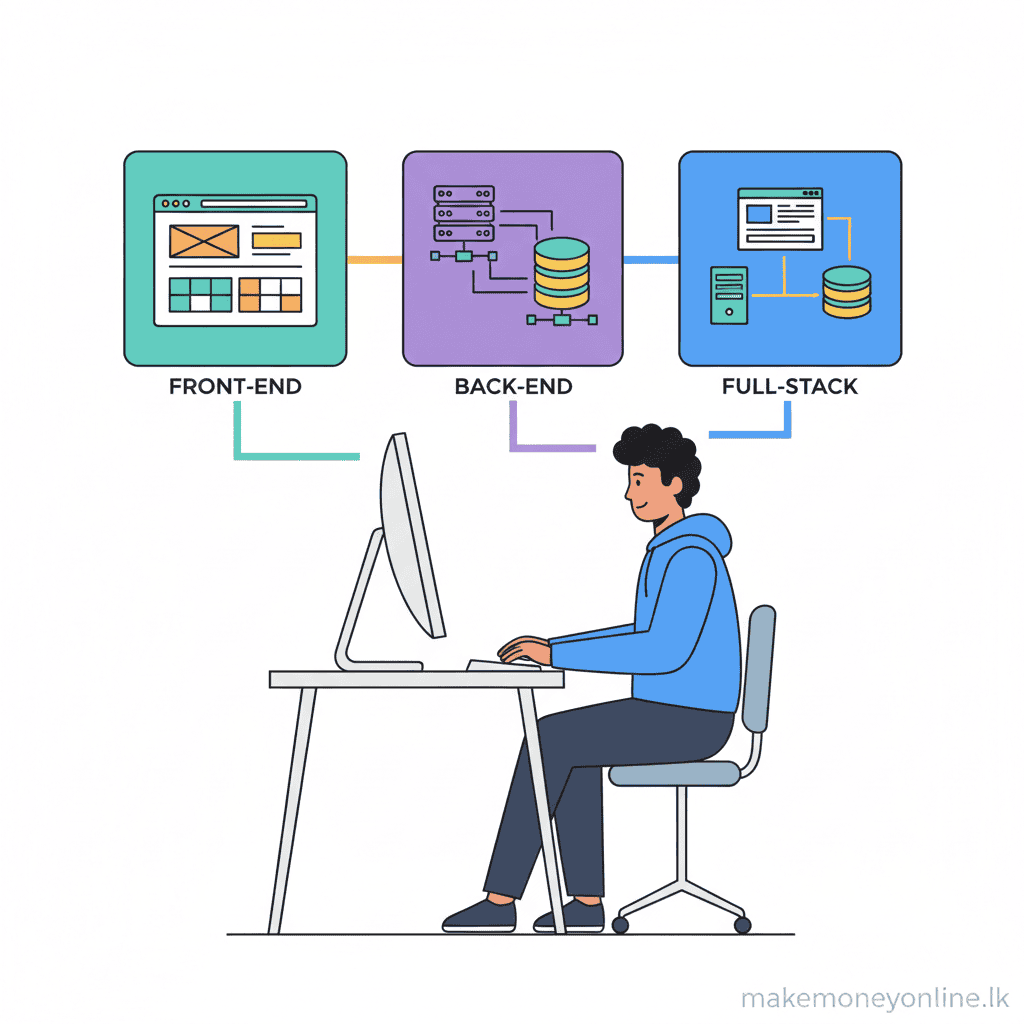
Web development splits into two main areas. Front-end development focuses on the visual side of a website. This includes the layout, buttons, images, fonts, and everything the user sees and interacts with. Back-end development handles the invisible side: servers, databases, and the logic that processes data. Full-stack development means doing both.
Web development is different from web design. A web designer decides how a site looks. A web developer makes it work. Many freelancers do both, especially when starting out.
As a Sri Lankan, you can offer web development services to clients in the US, UK, Australia, Canada, and Europe. You earn in USD or GBP, convert to LKR, and the exchange rate works strongly in your favor.
How Much Can You Earn from Web Development in Sri Lanka?
Sri Lankan web developers on freelance platforms typically earn LKR 30,000 to LKR 150,000 (USD 100 to USD 500) per month during their first one to two years. Experienced developers working with regular foreign clients earn LKR 150,000 to LKR 600,000 (USD 500 to USD 2,000) per month. Full-time remote developers at international companies can earn LKR 600,000 to LKR 1,500,000 (USD 2,000 to USD 5,000) per month.
Earning Potential by Level
Beginner (0 to 12 months of experience)
- Monthly earnings: LKR 15,000 to LKR 50,000 (USD 50 to USD 150)
- What this requires: Basic HTML, CSS, and JavaScript skills. Simple WordPress sites and small freelance projects.
- Reality: Most beginners struggle to land their first client for 2 to 4 months. The income is low at this stage, but the foundation you build here determines how fast you grow.
Intermediate (1 to 3 years)
- Monthly earnings: LKR 75,000 to LKR 200,000 (USD 250 to USD 650)
- What this requires: Proficiency in one front-end framework (React or Vue), basic back-end skills (Node.js or PHP), and a portfolio of 4 to 6 completed projects.
- Reality: This is where most Sri Lankan freelancers land after consistent work. LKR 100,000 per month is achievable at this level.
Experienced (3 to 5+ years)
- Monthly earnings: LKR 250,000 to LKR 600,000+ (USD 800 to USD 2,000+)
- What this requires: Full-stack skills, specialization in a niche (e-commerce, SaaS, fintech), and a reputation built through reviews and referrals.
- Reality: Developers at this level often work with long-term retainer clients and command USD 50 to USD 100+ per hour.
Remote Full-Time
- Monthly earnings: LKR 600,000 to LKR 1,500,000 (USD 2,000 to USD 5,000+)
- What this requires: Senior-level skills, strong communication, and getting hired by a foreign company on a remote contract.
- Reality: This path exists for Sri Lankan developers, but it requires a strong portfolio and sometimes 4 to 6 years of experience.
Local Employment Salary Ranges in Sri Lanka (LKR/Month, 2026)
| Role | Entry Level | Mid Level | Senior Level |
|---|---|---|---|
| Junior Web Developer | LKR 50,000-80,000 | LKR 90,000-130,000 | LKR 150,000-200,000 |
| Mid-Level Developer | LKR 100,000-150,000 | LKR 160,000-220,000 | LKR 250,000-350,000 |
| Senior / Full-Stack | LKR 180,000-250,000 | LKR 270,000-380,000 | LKR 400,000-600,000+ |
| Freelance (per project) | LKR 50,000-150,000 | LKR 200,000-500,000 | LKR 500,000+ |
Last updated April 2026. Salary data sourced from LinkedIn, Glassdoor, and local Sri Lankan job boards.
How Does Web Development Work as an Income Method?
There are three main ways to earn money as a web developer in Sri Lanka.
Freelancing on Global Platforms
You sign up on platforms like Upwork or Fiverr, create a profile showcasing your skills, and bid on or receive projects from clients around the world. Clients post projects such as “build a WordPress site,” “fix bugs on my React app,” or “create a landing page.” You complete the work, deliver it, and get paid.
Payments come through the platform. You withdraw to Payoneer, which connects to your Sri Lankan bank account. This is the most common path for beginners and intermediate developers.
Direct Clients
Once you have a reputation and a portfolio, clients find you through referrals, LinkedIn, or your own website. Direct clients pay more because there is no platform taking a commission (typically 10 to 20% on platforms). Building a direct client base takes time but significantly increases your earnings.
Remote Full-Time Employment
Some Sri Lankan developers get hired as full-time remote employees by companies in the US, UK, Australia, or Singapore. They work on a salary paid in foreign currency, deposited via Wise or direct bank transfer. This path offers stability but requires strong skills and interview preparation.
What Skills Do You Need for Web Development in Sri Lanka?
Web development has a clear skill hierarchy. You do not need all of them immediately. You build them in order.
Essential skills to start (first 3 to 6 months):
- HTML: The structure of every webpage. Not a programming language, but mandatory first step.
- CSS: Controls how HTML looks. Colors, fonts, layouts, spacing.
- JavaScript: The programming language of the web. Makes pages interactive.
Skills to add after the basics (months 6 to 18):
- A JavaScript framework: React is the most in-demand in 2026. Vue.js is a good alternative.
- Version control with Git: Every professional developer uses Git. Learn it early.
- Responsive design: Building sites that work on both desktop and mobile.
- WordPress: Knowing WordPress (including theme development and plugin customization) is valuable because a large portion of the web runs on it.
Back-end and full-stack skills (months 12 to 36):
- A back-end language: Node.js (JavaScript on the server), PHP, or Python.
- Databases: SQL (MySQL, PostgreSQL) and basic NoSQL (MongoDB).
- APIs: Understanding how to build and consume REST APIs.
Soft skills that are often underestimated:
- Clear written communication in English. Most of your clients will communicate in English.
- Meeting deadlines. Reliability earns long-term clients. Missing deadlines ends contracts.
- Breaking down a project and estimating time accurately. This comes with experience.
You do not need a computer science degree. Many successful Sri Lankan web developers are self-taught. A degree helps with large company hiring, but freelancing and remote work value skill and portfolio above credentials.
Web Development Tech Stack for Sri Lanka (2026)
Choosing the right technology stack determines how quickly you find work. Here is how each major stack is used in Sri Lanka.
React and Next.js
The dominant frontend stack in Colombo. Used by WSO2, Sysco LABS, and funded startups. Next.js is the default for production React apps and handles server-side rendering, routing, and API endpoints in a single framework. Safest bet for Sri Lankan tech companies and international remote roles. Most requested JavaScript framework on Upwork and Toptal.
Vue.js and Nuxt
Less common in Sri Lanka than React but growing. Vue has a gentler learning curve and is practical for smaller teams. Some Colombo agencies prefer Vue for client projects because developers can ramp up faster. Nuxt provides the Vue equivalent of Next.js for SEO-focused websites. Learning curve from React knowledge: days, not months.
WordPress and PHP
Powers approximately 40% of the entire web. The number one platform for local Sri Lankan businesses - restaurants, hotels, schools, service providers. Enormous consistent demand. Not glamorous, but the money is real and reliable. Many Sri Lankan freelancers earn their first international income through WordPress projects. PHP knowledge transfers directly to Laravel.
Laravel (PHP Framework)
The most popular PHP framework in Sri Lanka for custom applications. Used by multiple Colombo software houses for client work. Consistent local demand and a good international freelance market. Significantly increases your hourly rate compared to basic PHP work.
Python and Django
Popularity surged due to AI and data science interest. Used less for typical web projects but excels in data-heavy applications, dashboards, and backend APIs. Good choice if you want to combine web development with data science or machine learning work. Several Sri Lankan fintech companies use Python for their backend systems.
Node.js and Express
Enables full-stack JavaScript development - the same language on frontend and backend. The MERN stack (MongoDB, Express, React, Node) is popular with Sri Lankan startups and commonly requested by international clients for API development and real-time applications.
Practical advice: Pick one frontend framework (React is the safest choice) and one backend technology (Node.js for versatility or PHP/Laravel for local demand). Learn WordPress development alongside regardless of your primary stack. You can expand your technologies later as you earn.
How to Get Started with Web Development in Sri Lanka
Web development requires structured learning before you can start earning. This section gives you a step-by-step path from zero.
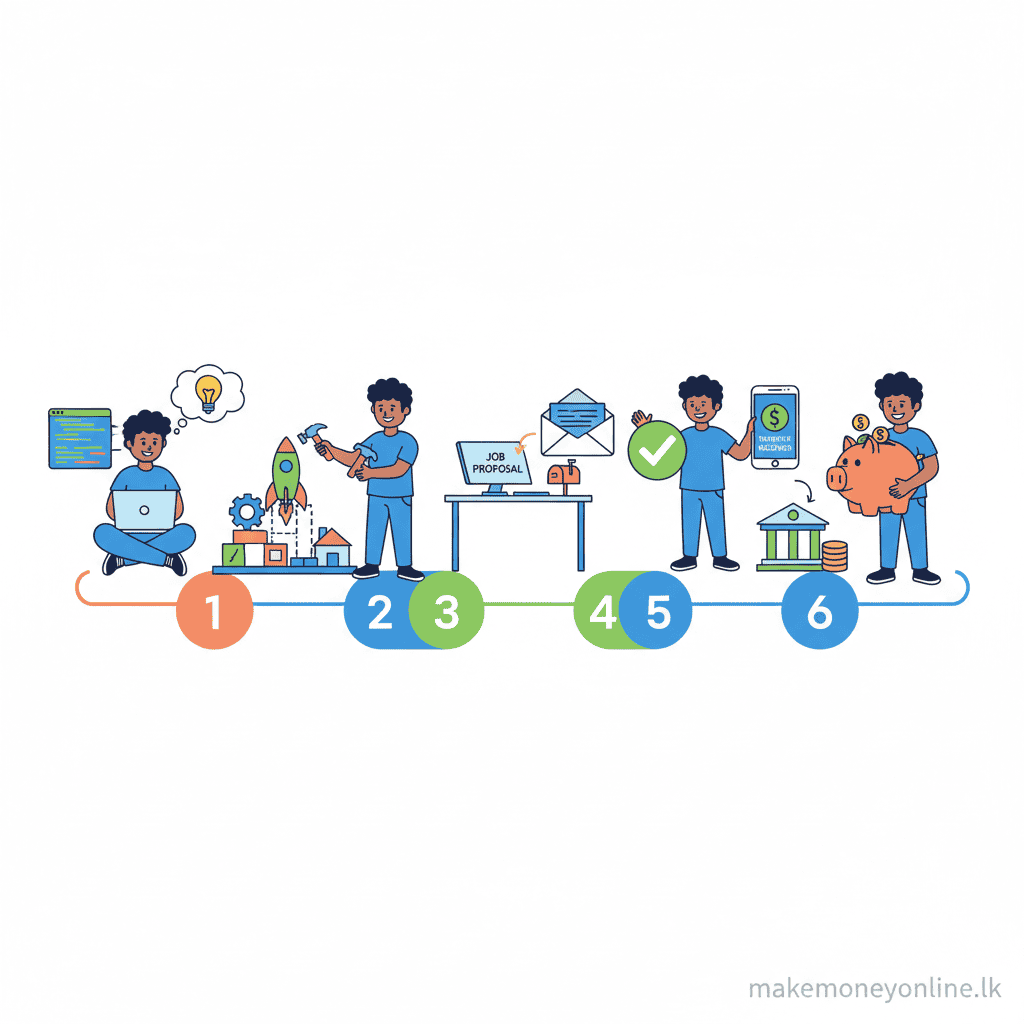
Step 1: Set up your learning environment
You need a laptop or desktop. Web development is difficult on a mobile phone, especially coding. A basic laptop (even older models running Windows or Linux) is sufficient to start. Install VS Code (free code editor from Microsoft) and Google Chrome.
You do not need a fast internet connection for most learning. Many tutorial videos can be downloaded or watched at lower resolution.
Step 2: Start with HTML and CSS (weeks 1 to 4)
Go to [freeCodeCamp.org](https://www. freecodecamp.org). Their Responsive Web Design certification is free and teaches HTML and CSS from zero. Complete the first section. Do not skip exercises. Type the code yourself rather than copying and pasting. Typing it builds muscle memory and understanding.
After freeCodeCamp’s basics, build a simple personal webpage. One page. Your name, a photo, and a few sentences. This is your first project.
Step 3: Learn JavaScript (weeks 4 to 12)
Return to freeCodeCamp and complete the JavaScript Algorithms and Data Structures certification. Also watch The Odin Project’s JavaScript section (free at [theodinproject.com](https://www. theodinproject.com)). JavaScript has depth. Do not expect to master it quickly. The goal at this stage is to understand variables, functions, loops, and basic DOM manipulation.
Step 4: Build 3 projects before applying for work
Before you apply anywhere, build three real projects. Suggested projects for beginners:
- A personal portfolio website (shows your HTML, CSS, and basic JavaScript)
- A simple to-do list app (shows JavaScript and DOM manipulation)
- A static website for a fictional local business (shows responsive design)
Host these on GitHub Pages (free) or Netlify (free). This gives you live URLs to share with potential clients.
Step 5: Create your Upwork or Fiverr profile
With 3 portfolio projects live, create a profile on Upwork or Fiverr. Write a clear profile description. Do not say “I am a passionate developer looking for opportunities.” Write what you can do: “I build responsive websites using HTML, CSS, and JavaScript. I specialize in small business websites and landing pages.”
Set your starting rate lower than you want to long-term. Getting your first review matters more than rate in the early weeks. LKR 5,000 to LKR 15,000 per small project is reasonable when starting.
Step 6: Apply for your first 10 projects
On Upwork, apply to 10 small projects in your first week. Most will not respond. That is normal. Write personalized proposals for each one. Read the job description and address the specific requirements. Generic proposals fail.
Your first project might pay LKR 5,000 to LKR 15,000. Take it. Complete it excellently. Get the review. That review starts your reputation.
Building a Portfolio That Gets Clients
Your portfolio is your most important tool for landing web development work. Here is how to build one that converts.
Which Projects to Build
Complete e-commerce store - A WooCommerce or Shopify store with checkout, payment integration, and order management. This proves you can handle the most common client request in Sri Lanka.
Local business website - Build a real website for an actual business, even if free or cheap. A live URL and a testimonial from a real client is worth more than ten practice projects nobody ever used.
Booking or reservation system - Hotels, tour operators, and restaurants in Sri Lanka need these. Calendar integration, email confirmations, and an admin panel shows complex functionality.
Dashboard or admin panel - Data visualization, user management, and analytics. Demonstrates you can build complex UI and work with APIs, which agencies value.
Your own portfolio site - The quality of your portfolio site is itself a demonstration of your skills. A slow, poorly designed portfolio undermines everything else in it.
How to Present Each Project Effectively
For each project, structure your presentation around four elements:
- The problem: What did the client need? What was broken or missing?
- Your solution: What you built, why you made the technical choices you did, tech stack, timeline, constraints you worked within.
- The results: Quantified metrics where possible - page load time improvements, mobile traffic increase, conversion rate change, booking volume. Even small numbers are credible.
- Screenshots and live links: Desktop and mobile versions. Before-and-after comparisons where relevant.
GitHub Profile Best Practices
- Pin your 6 best repositories with clear READMEs that include a description, screenshots, tech stack used, and setup instructions
- Write meaningful commit messages (“Fix cart total calculation when discount code is applied” not “fix bug”)
- Contribute to open source projects, even documentation fixes and small features
- Keep your contribution graph active - consistency matters more than intensity
- Add a professional profile README with your bio, tech stack, and links to your portfolio and LinkedIn
How to Learn Web Development for Free in Sri Lanka
You do not need to pay for courses to become a web developer. The free resources available today are better than most paid courses.
freeCodeCamp (freecodecamp.org) The best free resource for beginners. Structured curriculum, interactive exercises, and certificates. Complete the following in order: Responsive Web Design, JavaScript Algorithms and Data Structures, and Front End Development Libraries. All free, no registration fee.
The Odin Project (theodinproject.com) A free, project-based curriculum that teaches both front-end and back-end development. More comprehensive than freeCodeCamp. Takes longer, but produces developers with stronger foundations.
MDN Web Docs (developer. mozilla.org) The official documentation for web technologies. Not a course, but the most reliable reference for HTML, CSS, and JavaScript. Bookmark it. Use it every day.
YouTube Channels
- Traversy Media: Practical tutorials for all levels. Covers every major framework.
- Kevin Powell: The best CSS channel on YouTube.
- The Net Ninja: Clear beginner tutorials for React, Node.js, and more.
Paid options worth considering (once you are earning)
- Udemy courses (available for LKR 500 to LKR 2,000 during sales): Look for courses by Brad Traversy, Maximilian Schwarzmuller, or Colt Steele.
- Frontend Masters: USD 39/month but very high quality. Worth it at intermediate level.
Local learning in Sri Lanka ICTA Sri Lanka and some university extension programs offer coding workshops. These provide structured learning with local instructors, which helps some learners stay accountable. The quality varies. Do not pay significant money for local coding bootcamps without verifying outcomes from past graduates.
Pros of Web Development as an Income Method
High earning potential Web development commands some of the highest hourly rates in online freelancing. An experienced developer can charge USD 40 to USD 100+ per hour. At LKR 300 per USD, that is LKR 12,000 to LKR 30,000 per hour. Even at beginner rates, the income-to-time ratio is strong compared to most other online methods.
Strong demand, growing market Every business needs a web presence. New businesses launch constantly. Existing businesses need updates, redesigns, and new features. Demand for web developers consistently outpaces supply globally. This is not a method that will disappear.
Skills that compound Each project builds your skills. A developer who spent 3 years building projects knows far more than one who spent 3 years doing data entry. Your earning capacity grows with your skill, not just with time.
USD earnings protect against LKR devaluation Earning in USD and converting to LKR means your income automatically adjusts upward when the rupee weakens. This is a meaningful advantage during economic uncertainty.
Remote work flexibility Web development work is location-independent. You can work from any city in Sri Lanka, set your own hours within client expectations, and avoid commuting. This matters for quality of life.
Direct client relationships possible Unlike content platforms or survey sites, web development allows you to build long-term relationships with clients. Retainer arrangements (monthly maintenance, ongoing development work) provide stable, predictable income.
Cons of Web Development as an Income Method
Long learning curve You cannot earn meaningful income from web development in your first week or even first month. Realistically, plan for 3 to 6 months of learning before you land your first paid project, and another 6 to 12 months before your income becomes consistent. Most people who try web development quit during this phase.
Requires a computer You cannot build professional websites on a smartphone. A laptop or desktop is mandatory. If you do not own one, this becomes a real access barrier. Secondhand laptops in Sri Lanka start around LKR 30,000 to LKR 60,000 for machines capable of web development work.
Competitive on freelance platforms Upwork and Fiverr have many developers from India, Pakistan, Bangladesh, and Eastern Europe competing for the same jobs. Getting your first client is the hardest part. You will face rejection frequently in the early weeks.
Clients can be difficult Some clients change requirements after the project starts, delay payments, or request unlimited revisions. Learning to write clear project scopes and use contracts protects you, but dealing with difficult clients is part of freelancing.
Technology evolves constantly Web development frameworks and best practices change. What was standard in 2020 is sometimes outdated by 2026. You must keep learning. Developers who stop updating their skills see their earnings stagnate.
Irregular income when starting Early-stage freelancing is unpredictable. You might earn LKR 40,000 one month and LKR 5,000 the next. Building financial reserves before relying on freelancing income reduces stress during slow months.
Best Platforms for Web Development in Sri Lanka
Upwork
Upwork accepts Sri Lankan users and is the largest professional freelancing platform globally. Projects range from small fixes (USD 50 to USD 200) to large ongoing contracts (USD 1,000 to USD 10,000+). Upwork charges a 10% service fee on earnings.
Payment withdrawal to Payoneer works reliably for Sri Lankan developers. From Payoneer, you transfer to your Commercial Bank, Sampath Bank, or BOC account in LKR.
Upwork is competitive. Getting your first job requires a strong profile, targeted proposals, and patience. Once you have 3 to 5 reviews, getting more clients becomes significantly easier.
Fiverr
Fiverr is gig-based. You create a “gig” (a packaged service like “I will build a 5-page WordPress website for $150”) and clients find you. Sri Lankan users can join, create gigs, and get paid.
Fiverr works better once you have reviews. In the early stages, you may wait weeks before your first order. The platform charges a 20% commission. Withdrawal to Payoneer is available.
Fiverr suits developers who want to package services into standard offerings. Custom web development, landing pages, WordPress sites, and bug fixes all work well on Fiverr.
PeoplePerHour
PeoplePerHour accepts Sri Lankan users. Less competitive than Upwork for beginners, though the volume of projects is smaller. Hourly contracts and fixed-price projects both available. Payment via PayPal or Payoneer.
Freelancer.com
Freelancer.com accepts Sri Lanka. However, quality clients are less consistent compared to Upwork, and bidding wars drive prices down. Use it as a secondary platform, not your primary one.
Toptal
Toptal is a premium developer network for top 3% of developers globally. It does not accept beginners. Acceptance requires passing multiple technical interviews and code challenges. If you reach senior level, Toptal offers significantly higher rates (USD 60 to USD 150+ per hour). Worth applying to after 3 to 4 years of experience.
LinkedIn is not a freelancing platform, but it is where many Sri Lankan developers land remote full-time roles. Optimize your LinkedIn profile with your skills and portfolio links. Follow companies that hire remote developers. Apply to remote jobs directly. Some Sri Lankan developers get hired through LinkedIn without using a freelancing platform at all.
Direct Outreach
Once you have experience, building your own client base through direct outreach (emailing small businesses, connecting at local events, referrals from past clients) can replace platform dependence. Direct clients pay more because no platform takes a cut.
Remote Work Setup for Sri Lankan Developers
Getting the practical setup right makes the difference between a smooth freelancing experience and constant technical problems.
Internet Requirements
A minimum of 50 Mbps download and 20 Mbps upload is workable for most remote development. Dialog, SLT, and Hutch offer fibre in urban areas. Keep a 4G LTE connection from a different provider as backup. A UPS (uninterruptible power supply) for your router and computer gives you 30-60 minutes of buffer during power cuts - essential in areas with frequent outages.
Time Zone Management
- US clients (EST/PST): 10-13 hour difference. Morning work in Sri Lanka overlaps with late US afternoon. Asynchronous communication works better than real-time. Respond within 24 hours and deliver updates at end of Sri Lanka workday.
- UK clients (GMT/BST): 4.5-5.5 hour difference. The sweet spot for Sri Lankan developers. Good 4-5 hour overlap in Sri Lanka’s afternoon.
- Australian clients (AEST): 4.5-5.5 hours ahead. Good morning overlap in Sri Lanka. Underserved by Sri Lankan developers - an opportunity worth pursuing.
Payment Methods
Payoneer - The most popular choice for Sri Lankan freelancers. Receives payments from Upwork and Fiverr directly. Withdraw in LKR to Commercial Bank, Sampath, or BOC. 2-3 business day transfers. Competitive exchange rates.
Wise (TransferWise) - Often better exchange rates than Payoneer. Gives you virtual bank account details in USD, GBP, EUR, and AUD. Increasingly popular for direct client payments.
PayPal - Less favourable exchange rates and higher fees than Payoneer or Wise. Use only when clients insist.
Direct bank transfer (SWIFT) - Works for larger, established clients. Higher per-transaction fees. Best for monthly retainers above $1,000.
Tax Considerations
Freelance income is taxable in Sri Lanka. If your annual income exceeds the tax-free threshold, register with the Inland Revenue Department. Keep records of all foreign income, invoices, and business expenses. Business expenses are deductible - internet, equipment, software subscriptions, and coworking space all qualify. Consult a Sri Lankan tax advisor who understands freelance and foreign income before you start earning consistently.
Remote Collaboration Tools
- Communication: Slack for ongoing client communication, Zoom or Google Meet for video calls, Loom for async video updates (record yourself walking through completed work instead of scheduling a call)
- Project management: Trello for simple task tracking, Jira or Linear for larger teams, Notion for documentation and project wikis
- Version control: Git and GitHub are mandatory. Learn branching, pull requests, and code review workflows - these are expected by professional clients
- Time tracking: Toggl or Clockify for billing accuracy and understanding your real hourly rate
Free Tools for Web Development
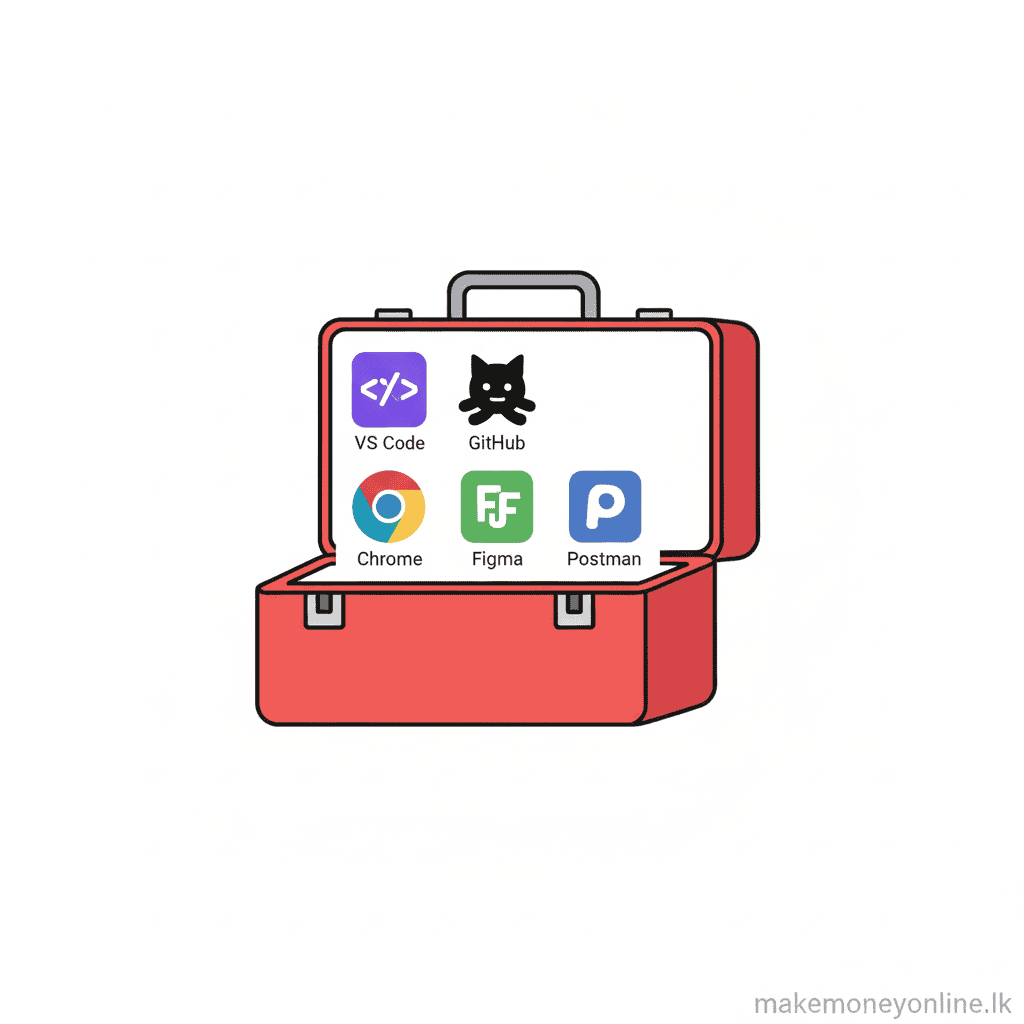
VS Code (Visual Studio Code) The most popular code editor in the world. Free, lightweight, and has thousands of extensions. Start here. Available at [code. visualstudio.com](https://code. visualstudio.com).
Git and GitHub Git is the standard version control system. GitHub hosts your code and acts as your public portfolio. Both are free for basic use. Every potential client will ask to see your GitHub profile.
Chrome DevTools Built into Google Chrome. Lets you inspect and debug websites in real time. Press F12 to open. You will use this constantly.
Figma (free plan) For designing layouts before building them. The free plan is sufficient for most freelance work. Clients sometimes send Figma files for you to convert to code.
Postman For testing APIs. Free to use. Essential once you move into back-end development.
Netlify / Vercel (free hosting) Host your portfolio and client project demos for free. Both platforms offer free tiers that handle most beginner use cases.
XAMPP or Laragon Local server environments for running PHP and MySQL on your own computer during development. Both are free.
Paid Tools for Web Development
GitHub Pro (LKR 600/month approximately, USD 4/month) Unlocks private repositories and additional features. Not essential when starting, but useful once you have client projects you want to keep private.
Figma Professional (LKR 4,500/month approximately, USD 15/month) Needed if you take on design-heavy projects. The free plan works for most developers.
Premium WordPress Themes and Plugins (LKR 3,000 to LKR 15,000 one-time per project) If you build WordPress sites, clients often require premium themes (Astra Pro, GeneratePress Pro) or plugins. Factor this cost into your project quotes. Do not buy these personally. Include them in the client’s project budget.
Course subscriptions
- Udemy: Individual courses at LKR 500 to LKR 2,000 during sales. Buy specific courses, not subscriptions.
- Frontend Masters: LKR 11,700/month (USD 39/month). Worth it at intermediate to advanced level.
Hostinger or SiteGround hosting (for client sites) When building sites for clients, you will sometimes manage their hosting. Hostinger starts at LKR 300 to LKR 700/month per site. Include hosting management as an add-on service.
Web Development Plus Digital Marketing: Higher Earnings
A developer who can build a fast, beautiful website is valuable. A developer who can build a fast, beautiful website that ranks on Google, converts visitors into customers, and integrates analytics tracking is worth two to three times more.
Adding digital marketing knowledge to your development skills is one of the most practical ways to increase your rates and attract better clients. Here is what to add:
SEO basics - Understanding keyword research, on-page optimization, internal linking, and technical SEO. This lets you charge a premium for “ranking-optimized” websites, not just functional ones. Many Sri Lankan businesses specifically want websites that rank locally.
Analytics implementation - Google Analytics 4, Google Tag Manager, conversion tracking, and event tracking. Agencies and marketing-focused clients pay specifically for accurate tracking setup. Most developers do not offer this, which makes it a differentiator.
Core Web Vitals and page speed - Core Web Vitals are a direct ranking factor in Google. Image optimization, lazy loading, JavaScript minimization, and caching affect both SEO and user experience. Knowing how to audit and improve these shifts your role from implementer to consultant.
Conversion rate optimization basics - Understanding how visitor behavior affects outcomes, what makes effective calls-to-action, and how page layout affects conversions. This moves you into strategic territory that commands higher rates than implementation work alone.
For a deeper understanding of the digital marketing side, read Digital Marketing Courses in Sri Lanka alongside your development learning.
Common Mistakes Sri Lankan Web Developers Make
These mistakes cost developers months of wasted time and thousands in lost income.
1. Underpricing work - Sri Lankan developers frequently bid LKR 40,000 on projects that should cost LKR 120,000-200,000. Low price does not win quality clients - it signals low confidence and attracts difficult clients. Research what developers in Eastern Europe and Latin America charge for equivalent work, as these are your real competitors on international platforms, not other Sri Lankans.
2. Not specializing - “I can do anything” profiles fail. “I can do anything” reads as “I am not particularly good at anything.” “WordPress e-commerce specialist for restaurants and hospitality” wins jobs. Specialization feels limiting until the inquiries start coming in.
3. Ignoring soft skills - Communication determines whether clients rehire you. Practice writing clear project proposals, giving proactive updates without being asked, and asking clarifying questions before starting work rather than after. Reliability earns long-term clients.
4. Not building a personal brand - No blog, LinkedIn presence, YouTube tutorials, Stack Overflow contributions, or GitHub activity. Personal brand compounds over 6-12 months and generates inbound clients who already trust you. Inbound clients pay more than clients you chase.
5. Staying too long in underpaying local roles - Loyalty to an employer who gives 5% annual raises while your market value increases 30-40% per year is a career mistake. Regularly check what your skills are worth externally. Job switchers in Sri Lanka’s tech sector are consistently rewarded more than loyalists.
6. Tutorial hell - Watching 200 hours of YouTube tutorials without building real projects does not make you a developer. Follow the 20% learning, 80% building rule. The real learning begins the moment you close the tutorial and try to build something on your own.
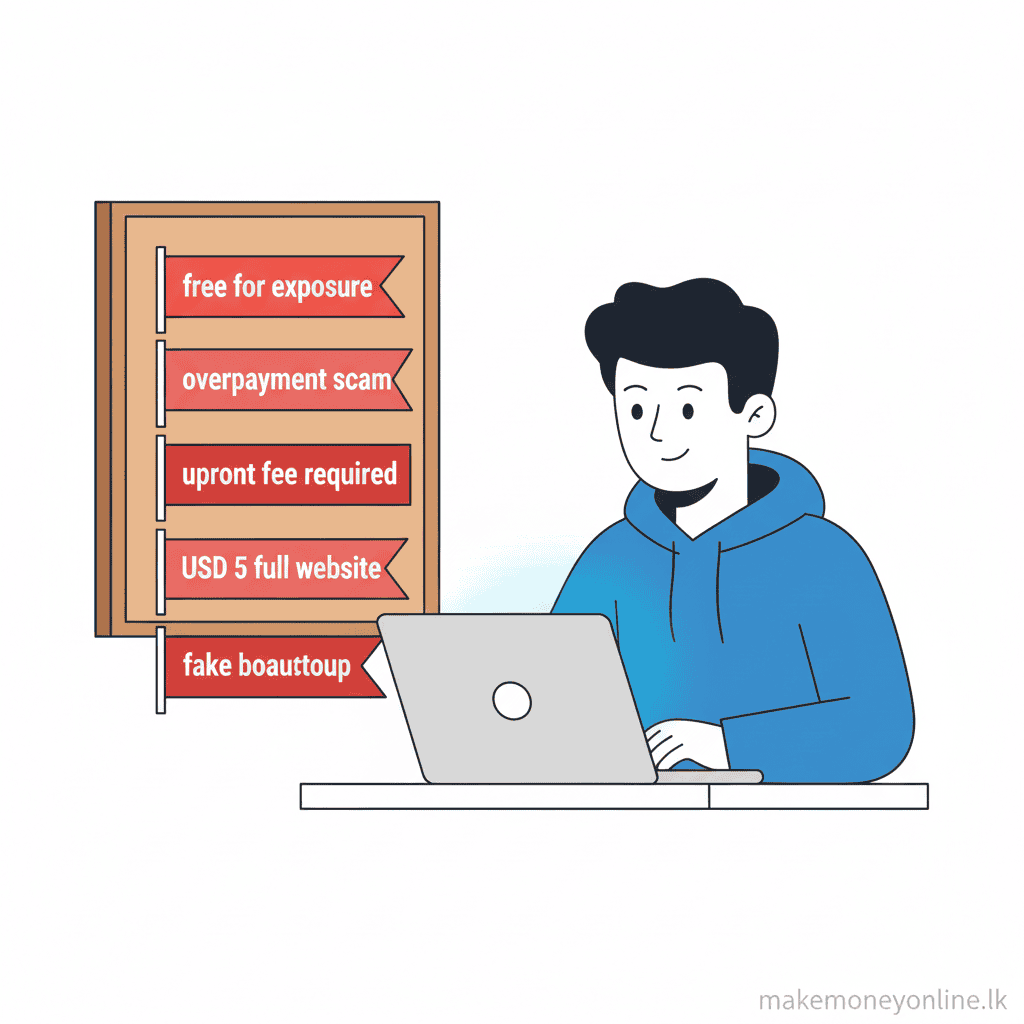
Scam Alerts: Web Development Red Flags in Sri Lanka
The “Build This for Exposure” Request
A client asks you to build a website or application for free or at a very low rate in exchange for “exposure” or “portfolio piece.” They promise future paid work once they see your skills. This is a common way to get free work from developers. Real clients pay. Exposure does not pay your bills.
Exception: If you genuinely want to build a specific type of project for your portfolio, you can volunteer for nonprofits. But this should be your choice, not a manipulation by the client.
Overpayment Scam
A client sends you a check or bank transfer for more than your agreed amount and asks you to refund the difference. The original payment turns out to be fraudulent, but by the time the bank reverses it, you have already sent money. This scam targets freelancers on less reputable platforms. Never refund “excess payments.” Report the client and cancel the project.
Fake Job Offers Requiring Upfront Payment
A “company” contacts you via Facebook or WhatsApp offering a remote web developer job with a high salary. To start, they ask you to pay for training materials, software licenses, or a registration fee. Real employers never ask job candidates to pay upfront for anything. This is always a scam.
Unrealistically Low Budget Requests
Clients who post jobs with budgets of USD 5 to USD 20 for a “full e-commerce website” are not real clients who will eventually pay more. They are hoping to find a desperate developer willing to massively underprice. Time spent on these projects is time not spent building skills or finding real clients. Know your minimum rate and stick to it.
Fake Coding Bootcamps in Sri Lanka
Some local “coding academies” charge LKR 50,000 to LKR 200,000 for bootcamps promising job placement and high salaries. Before paying, ask for names and contact details of past graduates. Ask what companies hired them and what salaries they received. Verify independently. Some are legitimate. Many overpromise and underdeliver.
Work-for-Hire NFT or Crypto Projects
Some clients ask developers to build platforms for cryptocurrency schemes, fake NFT marketplaces, or “investment platforms.” If a project description sounds like a get-rich-quick scheme, it probably is. Building software for fraudulent platforms could expose you to legal liability even if you are the developer and not the operator.
Final Verdict: Is Web Development Worth It for Sri Lankans?
Web development is one of the best long-term income methods available to Sri Lankans online, but it is not for everyone and it is not fast.
If you are willing to spend 3 to 6 months learning before you earn a single rupee, can access a laptop, and have enough English to communicate with foreign clients, web development is worth pursuing seriously. The income ceiling is higher than almost any other method covered on this site. The skills transfer into multiple paths including freelancing, remote employment, building a SaaS product, or even mobile app development.
If you need income in the next 30 days, web development is the wrong starting point. Consider data entry jobs or freelance writing for faster income while you learn development on the side.
Web development rewards patience. A developer who starts learning today and works consistently will be earning LKR 100,000+ per month within 18 to 24 months. That timeline is honest. The income is real. The work is hard. Whether that trade-off makes sense for you is the actual question to answer before starting.
For Sri Lankans who want to understand the full range of developer career paths and local salary expectations, this guide on web developer salaries in Sri Lanka on Advice.lk provides useful context alongside what you earn as a freelancer versus in a local company.
If you decide web development is right for you, start with freeCodeCamp today, not tomorrow. The 18-month path begins with the first line of code you write, not the day you decide to think about it.
Related methods to explore:
- SEO Consulting in Sri Lanka, another high-income skill-based method that pairs well with web development
- Digital Marketing in Sri Lanka, clients who hire developers often also need marketers
- Graphic Design for Sri Lankan Freelancers, design and development skills frequently go together in client work
Meta Title: Web Development in Sri Lanka: Earn LKR 100K+ Monthly (2026) Meta Description: Learn how to earn money from web development in Sri Lanka. Realistic LKR income, step-by-step guide, platforms, tools, and scam alerts for beginners. Primary Keyword: web development Sri Lanka URL Slug: /method/web-development/ Word Count: ~5,800
Related Ways to Earn Money Online in Sri Lanka
- SaaS Development — Build your own software products using development skills
- Mobile App Development — Extend web skills into mobile for broader client base
- SEO Consulting — Add SEO services alongside web development for clients
Looking for more ways to earn? Browse our complete guide to making money online in Sri Lanka with 63+ proven methods ranked by earning potential, skill level, and competition.


