
The best business bank in Sri Lanka is not necessarily the bank with the nearest branch or the lowest monthly account fee. It is the bank that can move your money safely on the days it matters: salary day, a large stock purchase, a tax deadline, an import payment or a slow-collection month.
For most SMEs, start with Commercial Bank, DFCC, HNB, NDB and Seylan. Commercial Bank has published a detailed ComBank Business platform; DFCC iConnect is built around payments and cash management; HNB publishes both transaction-banking and payroll-file services; NDB has a SME-focused NEOS Biz platform; and Seylan publishes both its corporate-online features and charges. Bank of Ceylon, Nations Trust and Sampath can be stronger fits when trade finance, collections, an existing relationship or API integration matters more than a single app feature.
This is a document-based comparison of public product information, not a test of apps, branches or credit approvals. Rates, limits, fees, cut-offs and eligibility can change. Confirm them in writing before opening an account or committing to a facility.
Quick comparison: best business banking in Sri Lanka 2026
| Bank | Published business platform | Payroll and bulk payments | Useful published strength | Confirm before opening |
|---|---|---|---|---|
| Commercial Bank | ComBank Business / ComBank Digital Business | Salaries, EPF/ETF, statutory and bulk payments | Multi-level approvals, CEFTS, SLIPS, RTGS, TT and ERP/API support | Migration status, package price and enabled payment rails |
| DFCC Bank | DFCC iConnect | Salary, vendor, utility and bulk payments | Cash management, ERP integration, reconciliation and mobile authorisation | Your iConnect tier, transaction limits and implementation cost |
| HNB | HNB TxB and PayFast | Payroll, suppliers, EPF/ETF, tax and statutory payments | SLIPS, CEFT, RTGS, OTT, ERP integration and multi-level authorisation | File-processing cut-offs, tariffs and trade-service scope |
| NDB | NEOS Biz / NEOS Corporate | Salary, supplier, single and bulk transfers | SME mobile users with assigned limits and approval roles | Employee/bulk-payment limits and applicable tariff |
| Seylan | Corporate Online Banking / Pay Direct | Salary uploads, bulk transfers, EPF/ETF and statutory payments | Published corporate-online fees and user controls | Current tariff, payment-file rules and CEFTS/SLIPS limits |
| Nations Trust | Transactional Banking | Payroll, interbank transfers, cash and cheque collection | Corporate current accounts, cash management and collection services | Digital channel, payment-file and authorisation options |
| Bank of Ceylon | Smart Online Banking Corporate / BOC Trade Channel | Confirm with the bank | Digital corporate trade-finance workflow | Daily payment tools, payment limits and SME account package |
| Sampath Bank | Business banking and API banking | Confirm platform workflow with the bank | Published SME/business-loan pricing and business APIs | Payroll upload, approvals, CEFTS/SLIPS and account fees |
The table is a starting point, not a service-quality ranking. It includes only claims the banks publicly describe. A blank or “confirm” field does not mean the bank lacks that feature—it means the current public material reviewed for this guide does not establish it clearly enough.
1. Commercial Bank: best for a broad digital-payment workflow
Commercial Bank is the most complete public comparison point if your company needs several payment types under one digital workflow. Its newer ComBank Business platform says it can manage SLIPS, CEFTS, RTGS, telegraphic transfers, payroll, bulk payments and scheduled transfers. It also describes role management, maker-checker and multi-level approval workflows, reports, cash pooling/sweeping and ERP/API connectivity.
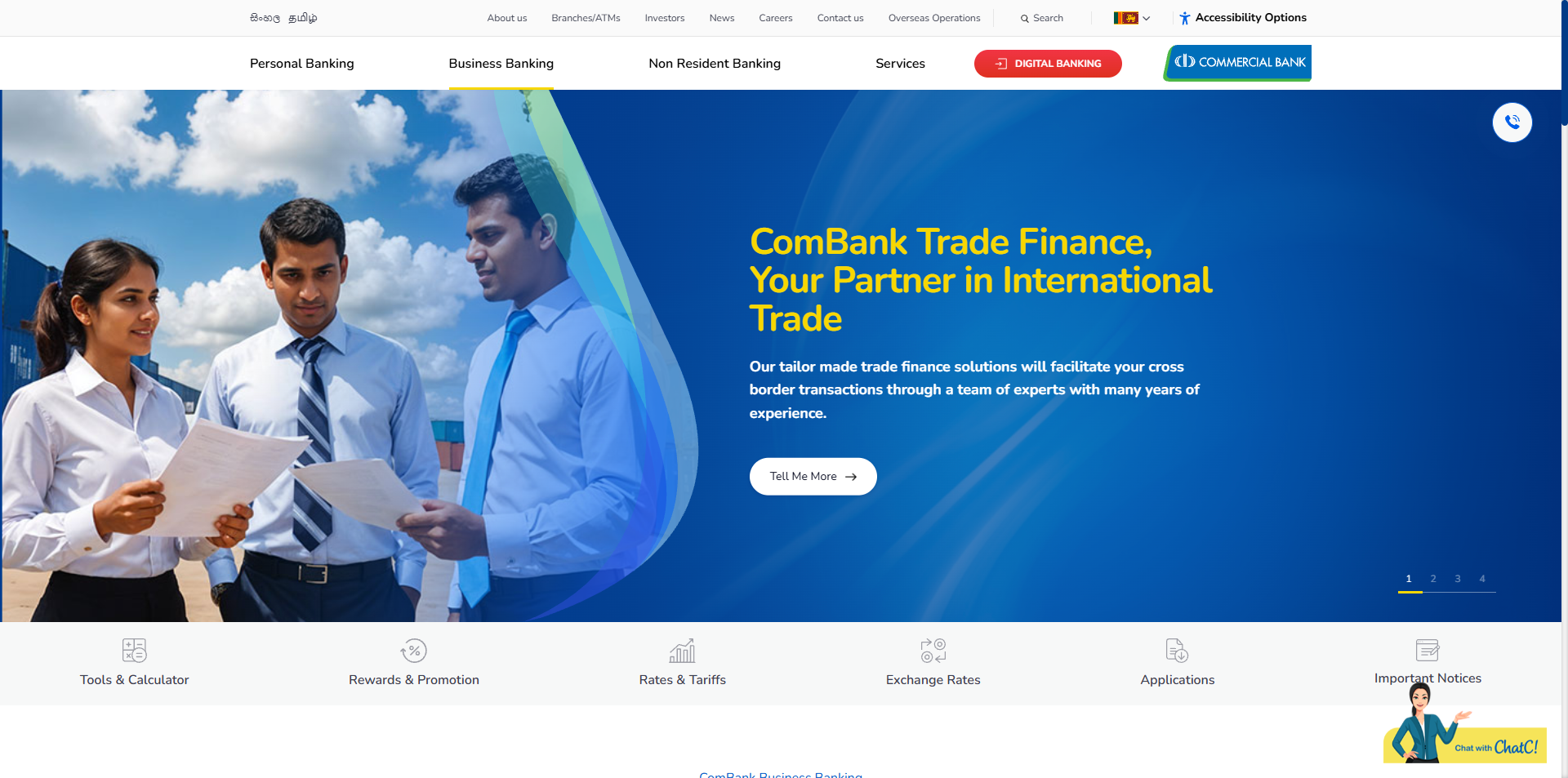
Commercial Bank still publishes information for ComBank Digital Business, which is available to SME and corporate customers with a business account. That page lists salary, EPF, ETF and government payments and an annual fee of LKR 1,500 per user. It also says a board resolution, user-information form and related registration documents are required. If your business is invited to move to ComBank Business, do not assume the legacy Digital Business tariff or every legacy feature will carry over—ask for the current written package.
Best for: an established SME or growing company that needs one place for payroll, statutory payments, payment approvals, reporting, trade/FX support and potentially an ERP connection.
Watch out for: a feature being listed online does not make it active by default. Confirm which payment rails, account types, user levels and integration services are included in your contract. Commercial Bank’s published tariff also says a business account with an average monthly balance below LKR 50,000 has a LKR 500 monthly charge, effective 1 July 2026; check the tariff that applies to your exact account type. See the current tariff.
2. DFCC Bank: best for SMEs that want payments and cash management together
DFCC is worth shortlisting early when you want the transaction account, payment platform and business-finance conversation in the same relationship. DFCC iConnect is positioned for SMEs, corporates and multinationals and publishes local and international payments, real-time balances and reports, automated collection/reconciliation, payroll and utility payments, mobile access, biometric authentication, digital signatures and ERP integration.
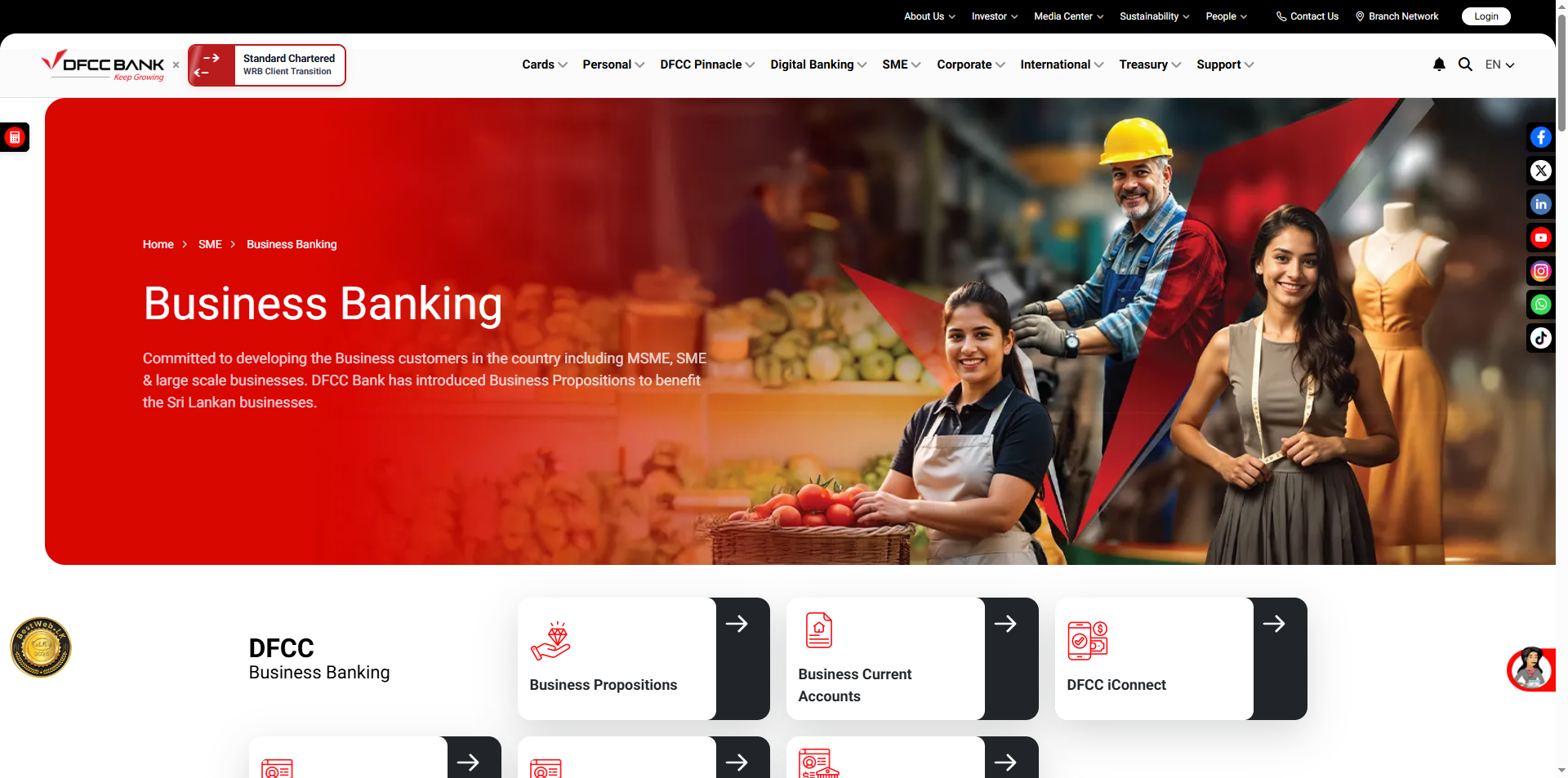
The DFCC business current account page explicitly names RTGS, CEFTS, SLIPS and payroll transfers. That is useful because these are the rails a business should ask about before moving its day-to-day account. iConnect’s published feature matrix also distinguishes between offerings: CEFTS, SLIPS and salary bulk payments appear across listed offerings, while RTGS, telegraphic transfers, vendor bulk payments, host-to-host/API connectivity and virtual accounts are associated with the full offering. Confirm the tier rather than assuming every feature is in iConnect Lite.
DFCC’s SME propositions may matter if your balances or borrowing are substantial. Its Silver Club lists iConnect Lite at a special LKR 1,500 rate and gives six-month-average-balance eligibility criteria. Its Diamond Club lists LKR 750 for iConnect Lite/mobile access for its highest tier, together with relationship and treasury support. Those published prices are not a quote for every business.
Best for: an SME that wants bulk payments, digital approval, reconciliation and possible ERP integration, while also considering an overdraft, short-term loan, leasing or guarantee.
Credit fit: DFCC publishes overdrafts and short-term loans for working-capital needs, business leasing for vehicles and equipment, and bank guarantees for bids, performance and advance payments. Approval, security and pricing depend on the business—not the app.
3. HNB: best for payment files, payroll and cross-border transaction banking
HNB publishes two useful layers of business-payment services. HNB PayFast is designed for company payments including payroll, suppliers, dividends, EPF, ETF and tax. It accepts uploaded files and says the bank processes files on normal working days, so a payroll team should ask about the final cut-off rather than assuming a 24/7 upload means 24/7 settlement.
For broader needs, HNB Transaction Banking lists payroll, suppliers, statutory and bill payments, cross-border and multi-currency payments, SLIPS, CEFT, RTGS and outward telegraphic transfers. It also lists ERP integration, beneficiary alerts, multi-factor authentication and a multi-level authorisation matrix.
Best for: a business that wants a clear payroll-file process today but may need trade, cross-border or more structured transaction banking as it grows.
Ask HNB: whether PayFast or HNB TxB is the right service for your turnover; whether a payroll file is checked before cut-off; whether a rejected employee account produces a downloadable exception file; and whether your required payment rails need separate enrolment or charges.
4. NDB: best for a mobile-led SME approval workflow
NDB is a strong candidate when the owner and finance team need to approve business payments from mobile devices without giving every employee the same authority. Its NEOS digital channels page separates NEOS Corporate for corporates from NEOS Biz for SMEs. The bank describes NEOS Biz as a mobile app in which the business can appoint users and assign limits and slabs for permitted transactions.
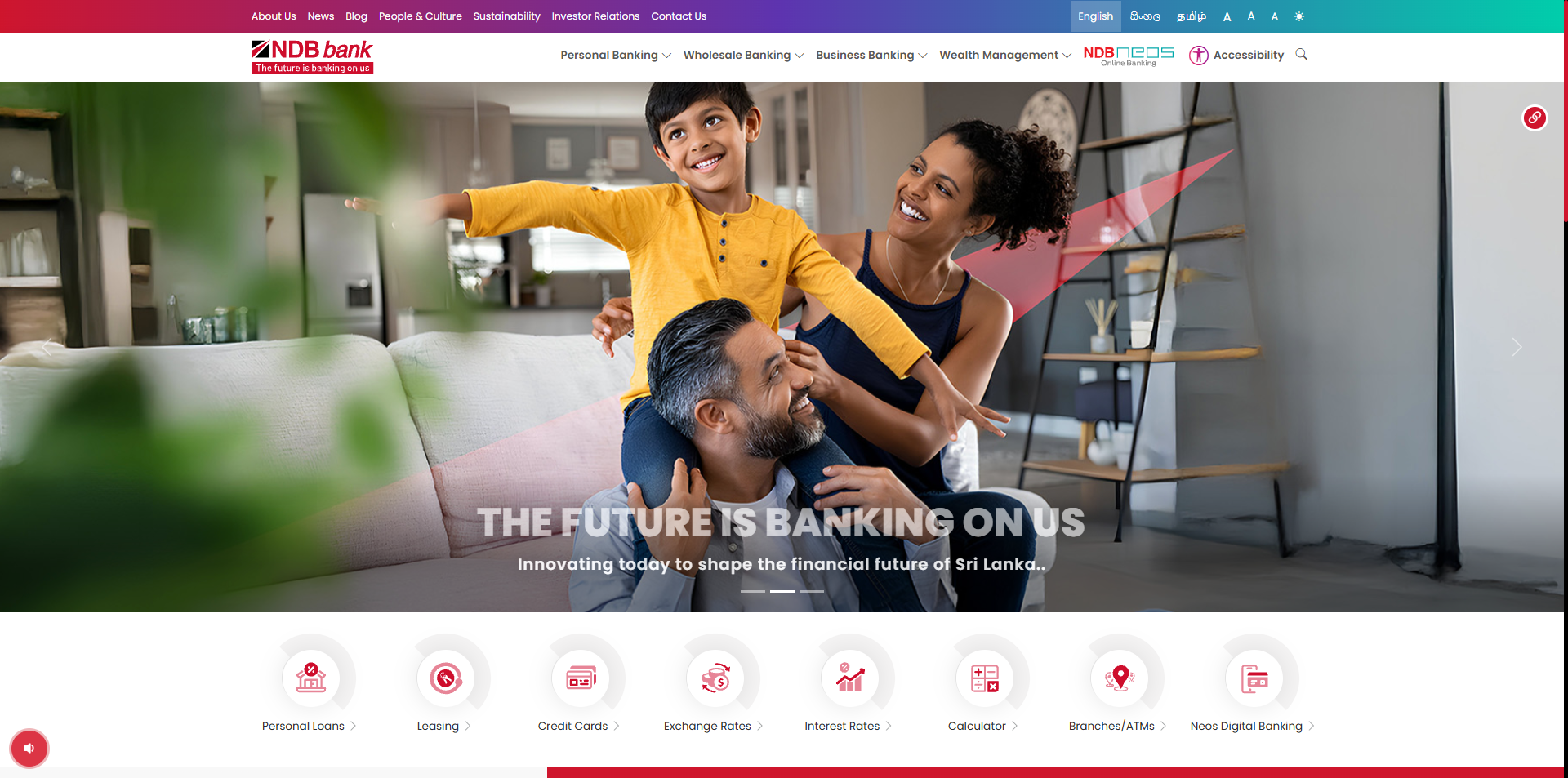
The published material describes real-time single and bulk transfers, bill payments, salary payments and merchant QR payments. NDB’s NEOS Biz key-fact document says that inputters and authorisers can be assigned, supports employee details and payments, and states a bulk salary run can include up to 50 employees at a time. It also notes that fees may apply under the bank’s tariff.
For a larger business, NEOS Corporate is described as a single window for cash and trade products, with account information, payments, liquidity and trade activities. NDB says it supports ERP and treasury-system integration. See NDB’s digital-channel details.
Best for: a growing SME that values mobile control, role-based limits and a route to a more complete cash-management and trade platform.
Watch out for: “up to 50 employees” is a feature of the published NEOS Biz document, not a universal payroll limit for all NDB business services. Ask whether your payroll size, payment volume and approval structure need NEOS Corporate instead.
5. Seylan Bank: best for transparent corporate-online pricing
Seylan is one of the clearer choices for a business that wants to see the published digital-banking price before a branch conversation. Its Corporate Online Banking page says the platform is available to sole proprietorships, partnerships, PLCs, clubs and societies. It lists current, savings, limited-liability and fixed-deposit accounts, multi-user initiator/approver access, bulk fund transfers and salary uploads, government payments, EPF/ETF records and downloadable statements.
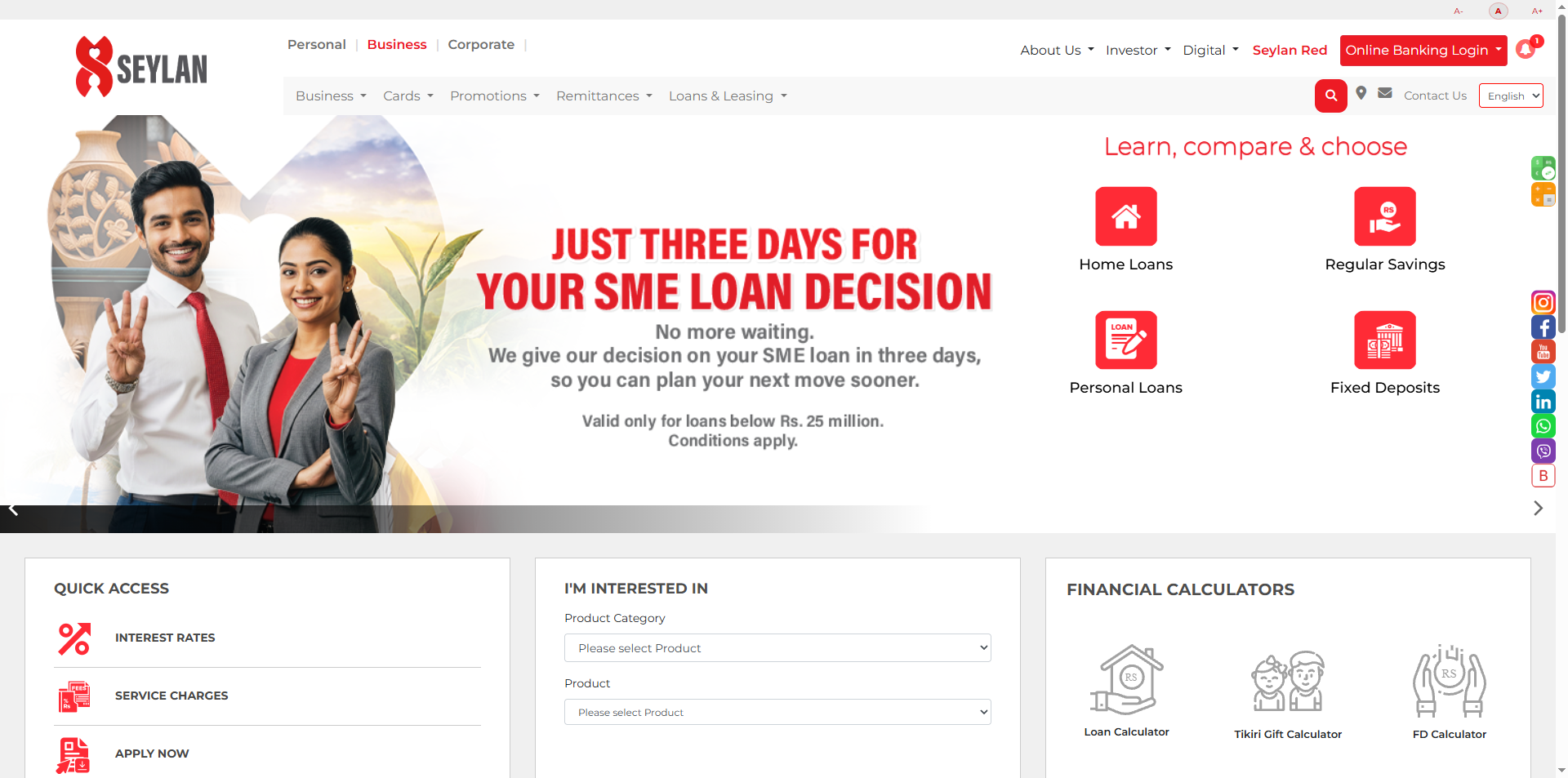
The page gives an annual LKR 1,500 charge for a single-user system, while Seylan’s service-charge page lists LKR 5,000 for two to five corporate-online users and LKR 1,000 for each additional user. The same tariff lists LKR 25 for a CEFT transfer, LKR 50 for a SLIPS transfer and says bulk/payroll pricing is customised. Treat these as dated tariff entries, not a replacement for a branch quotation.
Seylan’s Pay Direct page also lists salaries, bonuses, supplier payments, third-party bulk transfers, EPF/ETF, Customs, Inland Revenue, Ports, BOI and Import & Export Control payments, plus real-time reports for reconciliation.
Best for: a small or medium business that values a straightforward multi-user corporate-online setup and published pricing, including salary and statutory-payment support.
Ask Seylan: whether your business qualifies for Pay Direct, the corporate-online package that applies to your users, the CEFT/SLIPS limits configured for each approver, and the cut-off and error-handling process for payroll files.
6. Nations Trust Bank: best for cash management and collections
Nations Trust is especially worth comparing if the business needs more than outward payments. Its Transactional Banking page lists corporate current accounts, fixed deposits, money-market savings with an auto-sweep option, foreign-currency transaction management, cash management, payroll, interbank transfers and cash and cheque collection services.
That mix can suit a distributor, school, property manager or service business that receives a mix of cash, cheques and bank transfers, then needs to move funds to staff and suppliers. The public page does not provide the detailed digital user roles, file formats or charges needed to compare its platform feature-for-feature with ComBank Business, iConnect or NEOS Biz. Ask for a demonstration and a current tariff before making that comparison.
Best for: businesses that want a corporate current account alongside cash/cheque collection, payroll and interbank transfer services.
Ask Nations Trust: how collections are reported and reconciled; whether payroll can be uploaded; which payment rails are available online; and the authorisation, cut-off and pricing model for your turnover.
7. Bank of Ceylon: best for businesses with digital trade-finance needs
Bank of Ceylon should be on the shortlist where imports, exports, letters of credit or trade documentation are central to the business. BOC’s current online-banking page has a corporate login, while its 2024 corporate/offshore-banking report says it introduced BOC Trade Channel to let corporate customers process trade-finance banking transactions digitally. Read BOC’s corporate-banking report.
The same report says BOC introduced a trade-finance system for real-time online transactions and expanded its trade-finance operations. This makes BOC relevant for an exporter or importer, but an annual report is not a product tariff or onboarding guide. Do not assume the exact corporate-online payment functions, user controls or price from that report.
Best for: a SME or corporate customer whose main reason for changing banks is digital trade-finance access rather than only local payroll.
Ask BOC: whether BOC Trade Channel suits your business size, which trade requests can be submitted digitally, what document workflow remains at the branch, and whether Corporate Smart Online Banking handles CEFTS, SLIPS, payroll and multi-level approvals for your entity.
8. Sampath Bank: best for businesses that need SME finance and API options
Sampath should be compared when you want an SME/current-account relationship and may later need working capital, an overdraft or a business-system integration. Sampath’s published loan-and-advance rate sheet lists SME and other business loans/overdrafts at 14.00% or AWPLR + 3.00%, with a stated floor rate of 12.50%; the document says unspecified rates are floating. The sheet is dated 24 February 2025, so request the current rate and a full facility quote rather than treating it as a current offer.
Sampath also publishes a developer portal for banking APIs. That is potentially relevant for an established business whose accounting, e-commerce or ERP system needs bank-connected processes, but it is not a substitute for confirming cash-management, payroll and approval features. Its annual report confirms that SME and retail banking includes business loans and current accounts. See the Sampath annual report.
Best for: an existing or growing Sampath customer that values a business-loan relationship and wants to explore API-based integration.
Watch out for: the public sources reviewed here do not provide a clear, current equivalent to the detailed payroll and approval matrices published by Commercial Bank, DFCC, HNB, NDB or Seylan. Ask Sampath to show the real business-payment workflow before moving payroll.
CEFTS, SLIPS and RTGS: which payment method should your business use?
The payment rail matters more than a marketing label. Your bank should explain which route a proposed payment takes and what happens if it is rejected or needs a correction.
| Business task | Usually compare | What to ask the bank |
|---|---|---|
| Urgent supplier payment | CEFTS | LankaPay says CEFTS enables real-time transfers up to LKR 5 million, 24/7. See LankaPay’s CEFTS guidance. Ask for the limit on your company and each user. |
| Monthly staff salaries or recurring vendor payments | SLIPS or the bank’s bulk-payroll service | LankaPay describes SLIPS as same-day electronic processing for periodic or bulk corporate payments, including salaries. See LankaPay’s SLIPS guidance. Ask about file format, cut-off and rejected-account reports. |
| Large or time-critical domestic payment | RTGS | Ask about the bank’s cut-off, charge, payment evidence and approval path. |
| International supplier or trade payment | Telegraphic transfer/trade platform | Ask about FX rate timing, documents, sanctions checks, correspondent charges and tracking. |
| High-volume internal controls | Maker-checker workflow | Ask whether initiator, verifier and approver roles can have different limits and whether you can download an audit trail. |
The LKR 5 million CEFTS network ceiling is not automatically your company’s limit. The bank can set separate customer, account, user, device and daily limits. Have the business limit tested before the first large payment—especially if the owner has to approve a payment while away from the office.
How to compare a business current account properly
Use the same questions at every bank. This makes it much easier to compare a polished demo with the day-to-day process your staff will actually face.
- Account and signatories: What documents are required for a sole proprietorship, partnership or private limited company? How long does it take to add or remove a signatory?
- Approval controls: Can you use separate initiator, verifier and approver roles? Can limits differ by user, account and payment type?
- Payroll: Is there a file upload? Which format is accepted? What is the final cut-off? Does the system produce a clear rejected-payment file?
- Limits and fees: Request the charges for account maintenance, cheque books, CEFTS, SLIPS, RTGS, payroll, failed transfers and cash deposits. Ask for every limit in writing.
- Collections and reconciliation: Can the bank identify a payer through a reference or virtual-account process? Can statements and payment reports be exported for your accountant or ERP?
- Cash and cheques: If you still receive cash or cheques, which branches, machines, collection services and return-cheque process will your staff use?
- Credit: Which business facilities are actually available to your business—overdraft, working-capital loan, term loan, leasing, trade finance, invoice finance or guarantees? What security is required?
- Continuity: Who can help after hours if an approver loses a device, a payment file fails or a tax payment has not reached the recipient?
SME finance: choose the facility, not just the bank
A business current account does not guarantee an overdraft or loan. The lender will assess the legal business, ownership, cash flow, bank statements, tax records, existing debt, repayment ability and security. Read the facility letter, tariff and security documents before accepting credit. This is general information, not credit or legal advice.
- An overdraft may suit a short gap between paying suppliers and collecting from customers.
- A revolving or short-term loan may suit stock or a defined seasonal requirement with a clear repayment source.
- Leasing may suit a productive vehicle or machine when the repayment pattern matches the expected cash flow.
- Trade finance may suit imports/exports but needs careful understanding of documents, FX exposure, margins and timing.
- A bank guarantee may be needed for a tender, advance payment or performance obligation; understand the counter-indemnity and claim terms.
DFCC’s public SME pages are a good example of this distinction: it separately sets out overdrafts/short-term loans, leasing and guarantees. HNB, Commercial Bank, NDB, BOC, Nations Trust, Sampath and Seylan also have lending or trade propositions, but the right choice is the facility offered against your business cash flow and security—not a generic “best bank” claim.
Standard Chartered SME customers moving to DFCC: what to check
This is a live operational issue in 2026. DFCC’s Standard Chartered transition information says the retail, wealth and SME portfolios of Standard Chartered Sri Lanka are scheduled to move to DFCC on 31 July 2026. It says accounts and products are to be replicated at DFCC and identifies a service interruption during the migration period.
If your business is affected, confirm your individual position in writing before the migration weekend. Ask about account and bank-code changes, authorised signatories, payroll files, beneficiaries, trade instruments, cards, facilities, incoming-transfer instructions and digital credentials. A corporate or transaction-banking customer should not assume its treatment from a retail notice alone.
Final verdict: which bank should your business choose?
Start your comparison with Commercial Bank if you need a wide digital-payment stack and detailed approval controls; DFCC if iConnect, cash management and SME finance need to work together; HNB if payroll files, cross-border payments and transaction banking are central; NDB if mobile SME user controls matter; and Seylan if published corporate-online pricing and straightforward payroll features appeal.
Choose Nations Trust when collections and cash management are prominent, Bank of Ceylon when trade finance is the main decision factor, and Sampath when your SME finance relationship or API possibilities carry more weight. Get a written tariff and a live workflow demonstration from at least three banks before changing your operating account.
If your company is not yet formalised, start with our guide to registering a business in Sri Lanka. For personal spending rather than business expenses, see the best credit cards in Sri Lanka.

